To Contact Anchor Group, Please Provide The Preferred Method Of
Communication You Would Like To Use. You Can Share Your Contact
Information, Such As Your Email Address Or Phone Number, And We Will
Make Sure To Pass It On To The Appropriate Department At Anchor
Group.
Factory
To Contact Anchor Group, Please Provide The Preferred Method Of
Communication You Would Like To Use. You Can Share Your Contact
Information, Such As Your Email Address Or Phone Number, And We Will
Make Sure To Pass It On To The Appropriate Department At Anchor
Group.
Video
To Contact Anchor Group, Please Provide The Preferred Method Of
Communication You Would Like To Use. You Can Share Your Contact
Information, Such As Your Email Address Or Phone Number, And We Will
Make Sure To Pass It On To The Appropriate Department At Anchor
Group.
Can Spark Plugs Affect Your Vehicle’s A/C Performance?
Nov 14, 2025
Indirectly, spark plugs affect A/C performance. If it is severely misfiring, it can cause rough engine idling and reduced drivability, which in turn prevents the A/C compressor from maintaining a stable output, potentially resulting in lower cooling efficiency.
Outline
Introduction
The spark plug is a crucial component of an ignition system, delivering high-voltage electricity into the combustion chamber and producing a spark across the electrode gap to ignite the fuel-air mixture in the cylinder. While spark plugs are not a direct part of the vehicle’s air conditioning system, they can indirectly affect A/C performance.
Spark Plug’s Construction
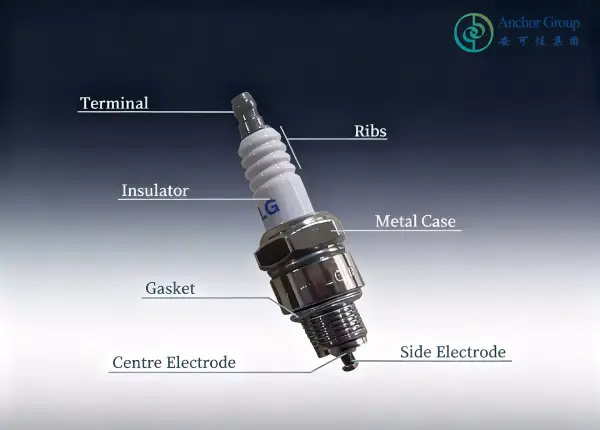
As a core component of the ignition system, the ignition plug consists of several key parts, each serving a critical function:
Terminal – connects the combustion plug to the ignition system, with designs adapted to different wire types.
Insulator – typically made of sintered alumina ceramic, providing electrical insulation, mechanical support, and heat resistance, with an extended path to prevent flashover.
Ribs – enhance surface insulation and prevent electrical leakage.
Metal Shell – ensures structural strength, dissipates heat to the cylinder head, and serves as the grounding path for the spark.
Seals – prevent combustion gases from escaping past the plug.
Central Electrode – generates the spark, often constructed from copper, nickel, or noble metals (platinum, iridium) for durability and efficient heat conduction.
Side (Ground) Electrode – completes the circuit; sometimes enhanced with precious-metal tips to extend service life.
Together, these components provide reliable ignition, effective heat management, and long-term durability under high temperatures and electrical stress.
Connection Between Spark Plugs and A/C System
In conventional vehicles, the air conditioning compressor is typically driven by the engine belt, so the engine’s condition directly affects the compressor’s smooth operation.
If combustion plugs are worn, fouled, or misfiring, the engine may experience vibrations, misfires, or reduced power, which can, in turn, affect A/C performance.
Common symptoms include:
Engine vibration → unstable compressor speed, resulting in uneven cooling
Reduced engine power → lower A/C airflow under high load
Difficulty starting the engine → A/C unable to operate properly
Although ignition plugs are not part of the air conditioning system, they indirectly influence A/C performance by affecting engine stability and power output. Regular maintenance of the plugs and the ignition system is essential for ensuring the long-term reliable operation of both the engine and the air conditioning system. It is recommended that professional customers routinely inspect spark plugs and replace worn components promptly to maintain overall vehicle performance.
FAQ
What is the purpose of a spark plug?
It ignites the fuel-air mixture in the engine cylinder, enabling the engine to run.
How do I know if my ignition plugs need changing?
Signs include worn electrodes, carbon buildup, corrosion, or mileage exceeding the manufacturer’s recommended interval.
Is it expensive to replace the plugs?
No, spark plugs are relatively inexpensive; labor cost may vary depending on engine type.
What happens if you wait too long to replace spark plugs?
Engine performance deteriorates, fuel consumption increases, misfires may occur, and it can damage the ignition system.





 English
  Português
  Español
  Русский
  Türkçe
  日本語
日本語  العربية
  Bahasa Indonesia
  한국어
한국어  Ελληνικά
  Português do Brasil