
For automotive distributors, fleet operators, and repair workshop owners, a working knowledge of the full AC system — not just individual parts — is the difference between accurate diagnosis and expensive guesswork. This guide breaks down how each component functions within the refrigeration cycle and what failure patterns look like in real-world operation.
The Refrigeration Cycle: What’s Actually Happening
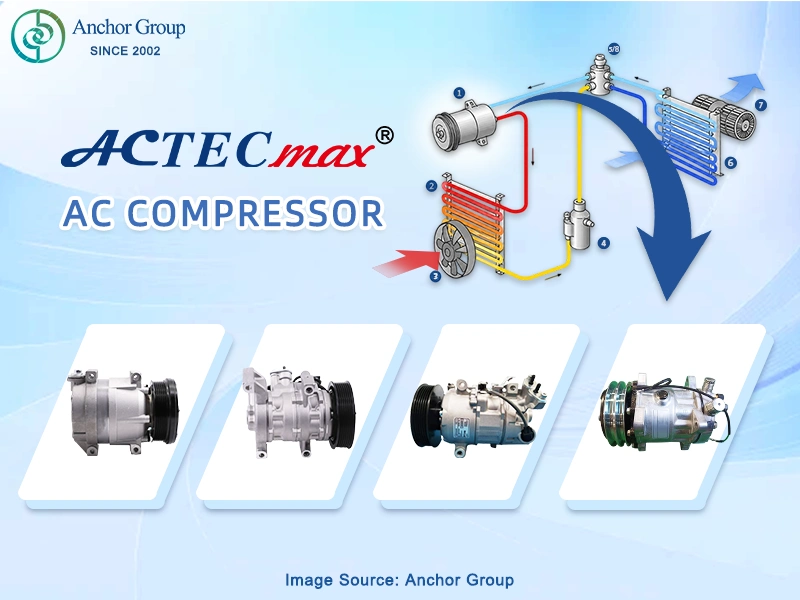
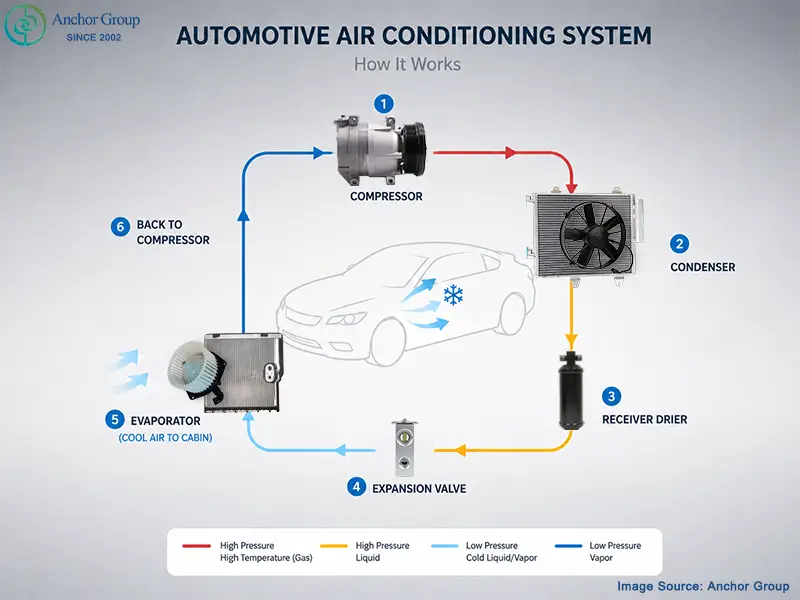
A car’s air conditioning system doesn’t generate cold air. It moves heat — extracting it from the cabin and releasing it outside. Refrigerant is the medium that carries heat through the loop, changing state between gas and liquid as pressure rises and falls across different sections of the circuit.
Every component in the system exists to support one or more phases of this cycle. When a single part underperforms, pressures shift across the entire circuit, and the effects often show up far from the source of the fault. That’s why systematic diagnosis — understanding how the loop behaves as a whole — consistently outperforms part-swapping based on symptoms alone.
Core Components: Function and Failure Patterns
Compressor
The compressor is the pressure source for the entire system. It draws in low-pressure refrigerant vapor from the evaporator side, compresses it into a high-pressure, high-temperature gas, and pushes it toward the condenser. In conventional vehicles, it’s belt-driven with an electromagnetic clutch. In EVs and hybrids, an electric compressor runs independently of engine speed — which matters for sourcing compatibility.
Common failure indicators:
- No cold air output despite clutch engagement
- Grinding or rattling on startup (bearing wear or internal damage)
- Clutch engages but immediately disengages — usually a low-pressure cutout triggered by refrigerant loss
- Rapid on/off cycling under normal conditions
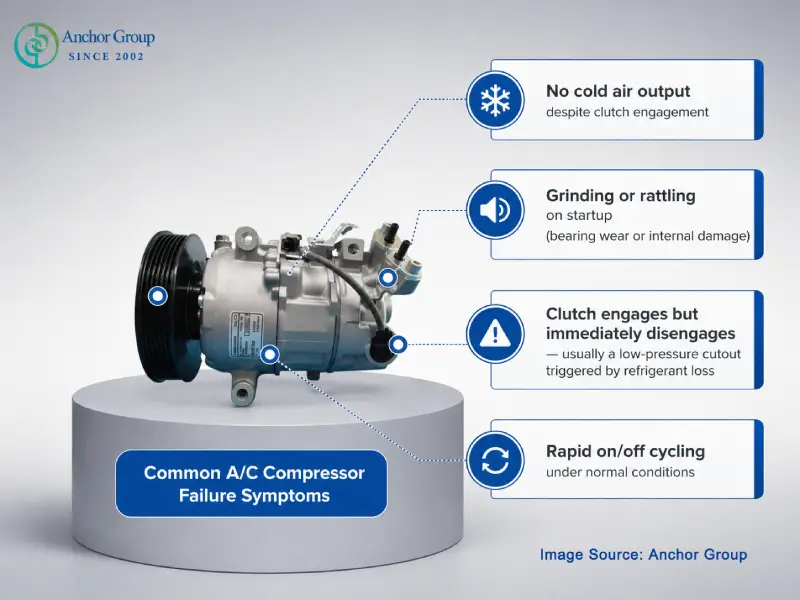
Compressor failures are rarely sudden. Gradual pressure loss, contaminated refrigerant, or a failing receiver-drier that allows debris to circulate will accelerate internal wear over months before a hard failure occurs.
Also Read: Signs of a Failing AC Compressor & 3 Maintenance Tips
Condenser
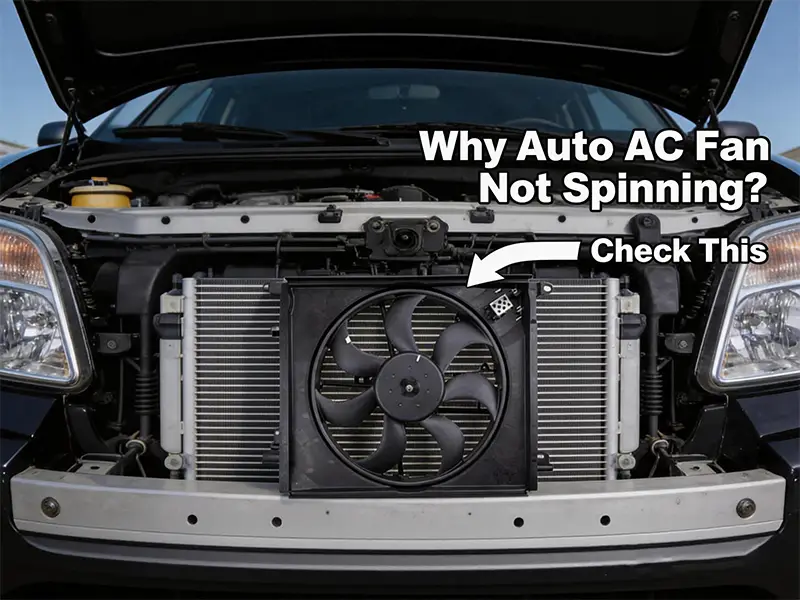
Positioned in front of the radiator, the condenser receives hot high-pressure gas from the compressor and dissipates that heat to outside air — converting the refrigerant back into a high-pressure liquid. At highway speed, ram airflow handles most of this work. At idle or in slow traffic, the condenser fan becomes critical.
Condenser efficiency directly determines high-side pressure. A degraded condenser forces the compressor to work harder, shortening its service life and increasing the risk of high-pressure shutdowns.
Common failure indicators:
- AC performs well at highway speed but drops off significantly at idle or in traffic
- High-side pressure readings above normal range
- Visible fin damage, blockage from debris, or refrigerant leaks at brazed joints
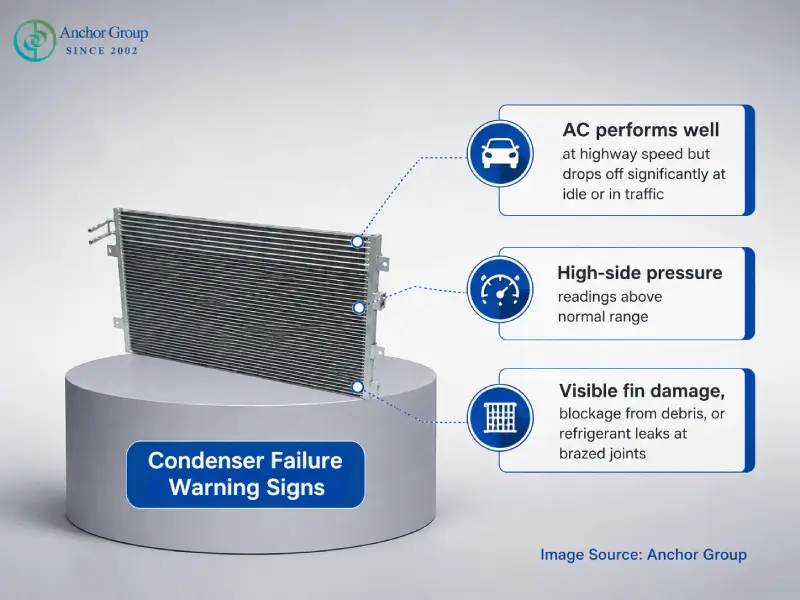
For B2B buyers, condenser compatibility requires attention to fin density, core dimensions, and inlet/outlet orientation — specifications that vary significantly across vehicle platforms even within the same model line.
Receiver-Drier
Moisture is the most damaging contaminant in a refrigerant circuit. Even trace amounts can react with refrigerant to form hydrofluoric acid, corrode metal components, and crystallize at the expansion valve — causing a blockage that mimics a low-charge condition. The receiver-drier filters moisture and particulates, and provides a buffer reservoir for refrigerant as demand fluctuates.
Systems with thermostatic expansion valves use a receiver-drier (high-pressure side). Systems with orifice tubes use an accumulator (low-pressure side). Both serve the same protective function.
Common failure indicators:
- Intermittent or gradually weakening cooling as desiccant saturates
- Ice formation or frost at the expansion valve
- Downstream compressor damage from circulating debris
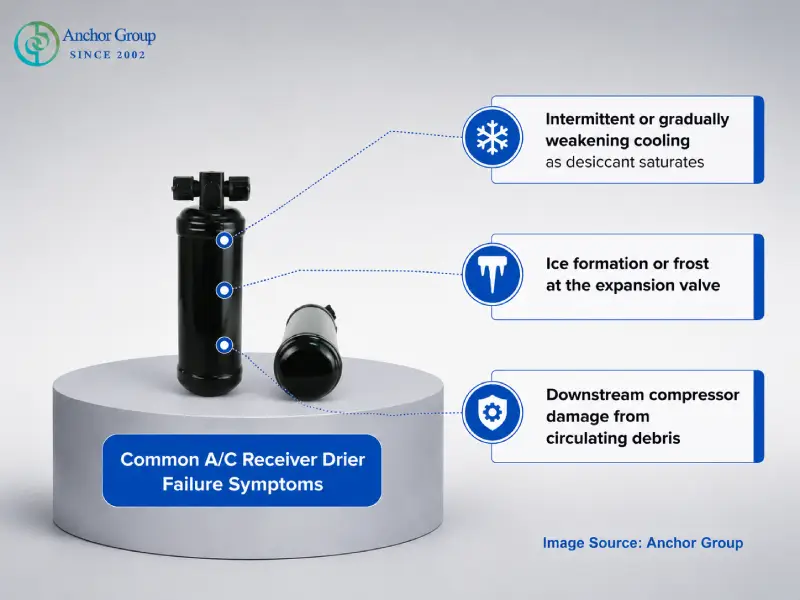
Industry standard practice is to replace the receiver-drier any time the system is opened for service. Reusing an old drier after atmospheric exposure defeats its purpose entirely.
Also Read: 7 Common AC Dryer Failures and Expert Solutions for Replacement and Maintenance
Expansion Valve
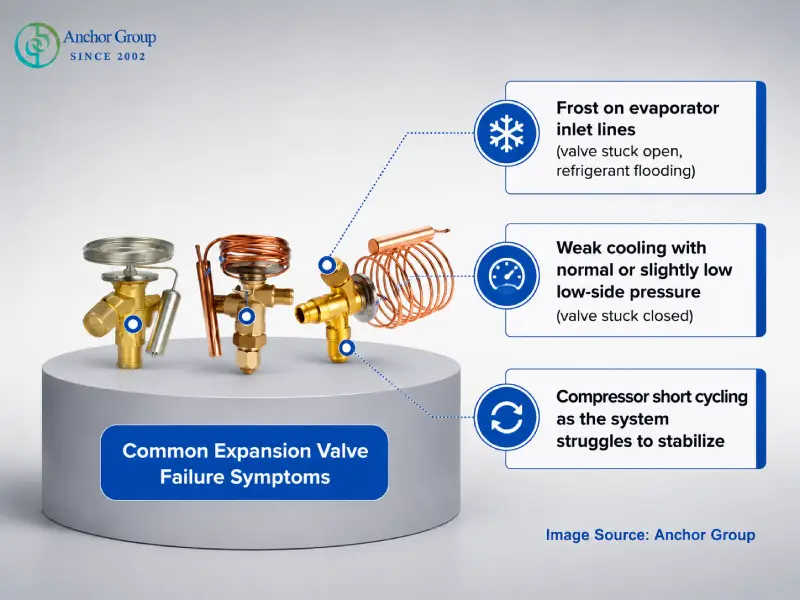
This is the pressure transition point in the circuit. The expansion valve (or fixed orifice tube) meters liquid refrigerant into the evaporator, causing a sudden pressure drop that allows the refrigerant to absorb heat. A thermostatic expansion valve (TXV) adjusts flow dynamically based on evaporator outlet temperature; an orifice tube uses a fixed restriction and is simpler but less adaptive.
Getting the right valve for a given platform matters. An oversized valve floods the evaporator; undersized starves it — both scenarios push the compressor into abnormal operating conditions.
Common failure indicators:
- Frost on evaporator inlet lines (valve stuck open, refrigerant flooding)
- Weak cooling with normal or slightly low low-side pressure (valve stuck closed)
- Compressor short cycling as the system struggles to stabilize
Also Read: Understanding the Function and Symptoms of a Faulty AC Expansion Valve
Evaporator
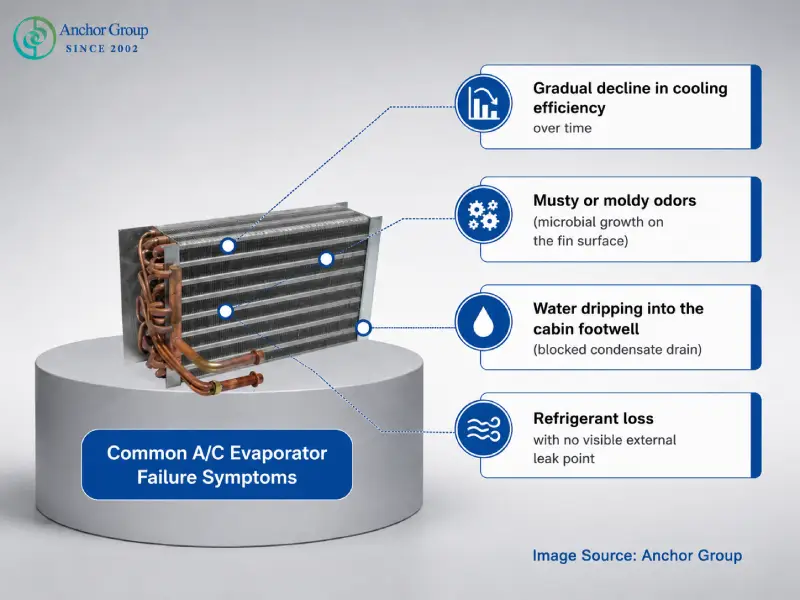
The evaporator is where heat transfer from the cabin air actually occurs. Low-pressure liquid refrigerant enters from the expansion valve, absorbs heat from the air stream passing over the fins, and evaporates into a gas before returning to the compressor. As a side effect, moisture in the cabin air condenses on the cold evaporator surface and drains out — which is why a functioning AC system also dehumidifies.
Evaporator issues are among the most labor-intensive to address because the component is typically buried behind the dashboard. Refrigerant leaks here are notoriously difficult to detect without UV dye or electronic leak detection.
Common failure indicators:
- Gradual decline in cooling efficiency over time
- Musty or moldy odors (microbial growth on the fin surface)
- Water dripping into the cabin footwell (blocked condensate drain)
- Refrigerant loss with no visible external leak point
Diagnostic Reference: Symptoms to System Areas
| Symptom | Primary Area to Investigate |
|---|---|
| No cooling, compressor not engaging | Refrigerant charge, clutch circuit, pressure switches |
| Cools at speed, fails at idle | Condenser fan |
| Frost on evaporator or inlet lines | Expansion valve (stuck open), moisture in system |
| Weak cooling with normal pressures | Evaporator airflow restriction, blower performance |
| Intermittent cooling, gradually worsening | Receiver-drier saturation, early compressor wear |
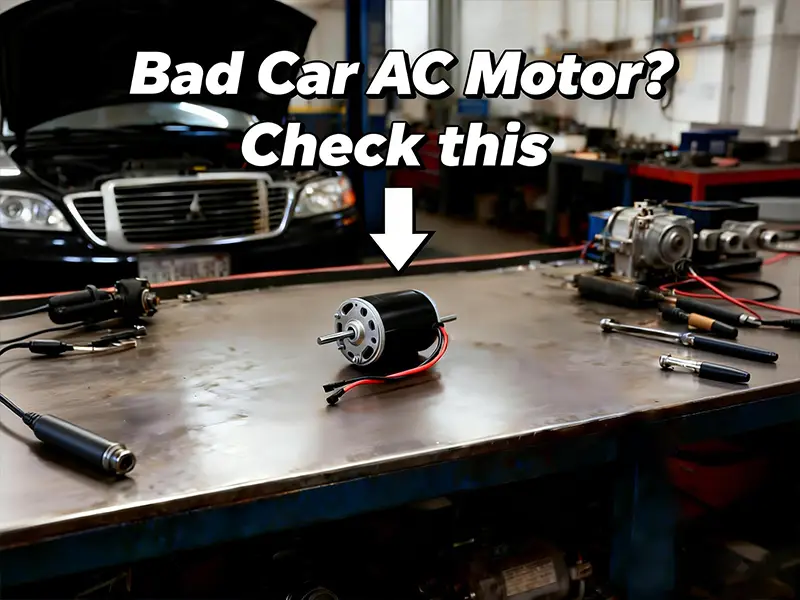
| No airflow from vents | Blower motor, resistor pack, cabin filter blockage |
| Refrigerant loss with no visible leak | Evaporator leak, compressor shaft seal |
| AC shuts down under load | High-pressure cutout — check condenser, condenser fan |
Reading both high-side and low-side pressures before replacing any component takes a few minutes and eliminates most of the ambiguity. The pressure profile, combined with temperature delta across the evaporator, points directly to the fault zone in the majority of cases.
What This Means for B2B Procurement
For distributors, workshop operators, and fleet service providers, component-level understanding has direct implications for parts sourcing decisions.
- Compressors require platform-specific compatibility checks — displacement, port configuration, mounting, and clutch voltage all vary. An OEM-specification replacement avoids the pressure imbalance issues that aftermarket mismatches can introduce.
- Condensers need dimensional accuracy and fin density matching to the original design. Undersized replacement condensers reduce system efficiency and increase wear on other components.
- Receiver-driers should be treated as a service item, not a repair-only replacement. Stocking them as a standard complement to compressor and condenser kits reduces return visits and customer complaints.
- Expansion valves are platform-specific to a degree that requires careful catalog matching. A valve calibrated for a different evaporator size will cause the system to run outside design parameters regardless of how good the other components are.
Sourcing all AC components from a single supplier with a verified cross-reference catalog significantly reduces compatibility errors — particularly for workshops handling multiple vehicle brands.
Working With a Reliable AC Component Supplier
For B2B operations managing high volumes of AC repairs or fleet maintenance programs, supply chain reliability matters as much as component quality. Inconsistent parts availability, mismatched specifications, or inadequate technical support creates downstream problems that affect shop efficiency and customer retention.
At Anchor Group, we supply the full range of automotive air conditioning components — compressors, condensers, evaporators, expansion valves, receiver-driers, blower motors, and condenser fans — engineered to OEM-level specifications and validated for compatibility across a broad range of vehicle platforms.
Our B2B services are built around the operational reality of distributors and service providers:
- Full-system component supply with cross-reference support across vehicle platforms
- OEM/ODM customization for regional market requirements or private-label programs
- Consistent quality control aligned with international standards
- Reliable logistics with lead times designed around workshop and distributor inventory cycles
- Technical support for installation, troubleshooting, and warranty handling
If you’re evaluating AC component suppliers or looking to consolidate your sourcing, contact our team for a product catalog and compatibility consultation.
Understanding the full AC system — not just the part that failed — is what separates fast, accurate diagnosis from expensive trial and error. For the workshops and distributors we work with, that knowledge translates directly into fewer comebacks, better technician efficiency, and stronger customer relationships.