
What Are Parking Heaters?
A parking heater, also known as a fuel-powered auxiliary heating system, is an independent unit that can operate both when the engine is off and while driving. Parking heaters are generally classified into two types: air heaters and water (coolant) heaters. Based on fuel type, they can be further divided into diesel and gasoline models. Diesel heaters are commonly used in large vehicles such as buses, RVs, and trucks, while gasoline heaters are typically installed in passenger cars. They are especially valuable for drivers in cold regions who need to rest or sleep in their vehicles while parked.
Where Are Parking Heaters Used?
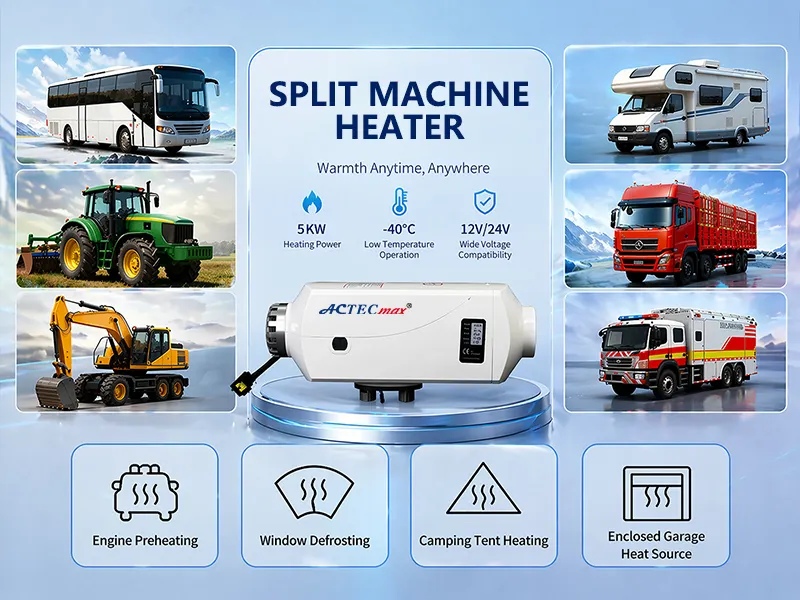
Parking heaters are widely used in vehicles and mobile environments that require warmth in cold climates.
- Heavy-duty trucks and long-haul vehicles commonly use them to provide overnight heating for drivers without idling the engine, saving fuel and reducing engine wear.
- In RVs and camper vans, they are essential for winter travel, ensuring a warm and livable space even when the engine is off.
- In construction machinery such as excavators, bulldozers, and agricultural equipment, they help operators start work quickly on cold mornings.
- For buses, coaches, and school buses, they ensure passengers enter a warm cabin during winter boarding and travel.
- They are also found in electric vehicles and special-purpose vehicles like mobile clinics, police command vehicles, and surveillance vans, where consistent internal heating is needed for both people and equipment.
How Do Parking Heaters Work?
The working principle of a parking heater involves drawing a small amount of fuel from the vehicle’s fuel tank into the heater’s combustion chamber. The fuel is then atomized and ignited, generating heat that warms either the engine coolant (in water heaters) or air (in air heaters). This heat is then transferred to the vehicle’s cabin via a heat exchanger and a blower fan. Simultaneously, the engine can also be preheated to improve cold start performance.
During operation, the system consumes both battery power and fuel. Depending on the heater’s capacity, each heating cycle consumes approximately 0.2 to 0.3 liters of fuel. A complete parking heating system typically consists of an air intake system, a fuel delivery system, an ignition system, a heat exchange system, and an electronic control unit. Its operation can be divided into five main stages: air intake, fuel injection, fuel-air mixing, ignition and combustion, and heat exchange.
Basic Workflow:
- System Activation: The heater is started via a controller, either manually or by remote.
- Fuel Supply & Ignition: An internal fuel pump draws diesel from the tank and delivers it to the combustion chamber, where it is ignited.
- Combustion Heating: Diesel burns within the combustion chamber, producing high-temperature exhaust gases. Heat is transferred to an aluminum heat exchanger.
- Fan-driven Warm Air Output: A fan pulls in cool air and pushes it through the heat exchanger, blowing warm air into the vehicle cabin or specified area.
- Temperature Regulation: Temperature and fan speed are controlled via a user interface. Some models support feedback-controlled temperature and programmable timers.
What Can a Parking Heater DO for Your Vehicle?
- Cabin Heating: Provides warm air to the cabin or cargo area without requiring the engine to start, ensuring comfort in cold environments.
- Engine Preheating (for applicable models): Preheats the engine or coolant, reducing cold-start wear and improving start-up reliability.
- Anti-Freeze Protection: Prevents components such as fuel, batteries, wiring, and hydraulic systems from freezing in extremely cold temperatures.
- Overnight Heating: Especially useful for truck drivers and RV users sleeping inside the vehicle overnight, offering stable warmth and safety.
- Timer Control / Smart Thermoregulation: Some models feature programmable timers, automatic temperature control, and remote operation for customized heating management.
- Low Fuel Consumption, High Efficiency: Consumes only about 0.2–0.5 liters of diesel per hour, offering energy efficiency and environmental friendliness.
Where Are Parking Heaters Commonly Installed?
1.Recommended Installation Locations
| Vehicle Type | Recommended Installation Position |
| Truck | Front of the cabin, between or under seats, rear box |
| RV | Behind driver’s wall, luggage/tool compartment, or vehicle underbody (with splash protection) |
| Bus | Under the passenger area floor, the rear compartment, or the chassis underside |
| Excavator | Inside or behind the driver’s seat, or inside the protective box |
Note: Always leave sufficient space around air intake, ignition components, and the control unit for proper installation and maintenance.
2.Installation Notes
- After installation, start the heater multiple times to purge air from the fuel line.
- All piping connections must be secure and free of bends or leaks to avoid startup failure or uneven heating.
- Do not direct the exhaust pipe toward areas where people work. Replace it with an OEM part if used for more than 10 years.
- Before welding on the vehicle, disconnect the heater’s positive power supply to protect its control board.
- Storage temperature must be maintained between -40°C and 85°C.
For Further Information About Installing A Parking Heater, Please Download Heater Instruction Manual!