
When choosing a vacuum pump for automotive air conditioning, buyers should look beyond the rated pumping speed and promotional claims such as “high efficiency.” Pumping speed indicates how quickly the pump can remove gas, while ultimate vacuum describes the lowest pressure the pump can achieve under specified conditions. Power supply, inlet fitting size, oil requirements, and operating conditions also affect whether a unit is suitable for its intended application.
Understanding these specifications helps distributors, wholesalers, automotive A/C repair shops, and refrigeration equipment buyers make informed purchasing decisions. For B2B buyers, selecting the right automotive A/C vacuum pump requires evaluating its technical specifications, target applications, and compatibility with existing equipment.
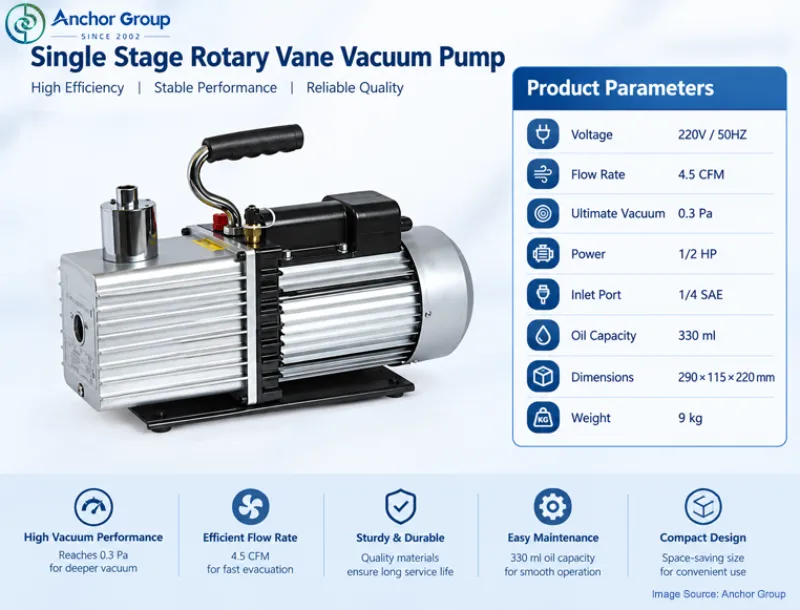
In this article, Anchor Group, a one-stop manufacturer and supplier of automotive A/C parts and systems, explains key vacuum pump specifications using model AC.140.007 as an example. This model is specified with a rated pumping speed of 4.5 CFM, a 220V~/50Hz power supply, and a 1/4 SAE inlet fitting. The following guide outlines what these specifications mean and what buyers should verify before placing a bulk order.
What Applications Is a 4.5 CFM Vacuum Pump Suitable For? Don’t Choose Based on Vehicle Type Alone
Pumping speed (“flow rate” in the above picture)is an important factor when selecting an automotive A/C vacuum pump. In general, a higher CFM rating indicates a greater gas-removal capacity, while a lower rating indicates a lower pumping speed.
With a rated pumping speed of 4.5 CFM, the pump can theoretically move approximately 127 liters of gas per minute under the conditions associated with that rating. For comparison, 127 liters is equivalent to the volume of approximately 127 one-liter water bottles.
However, 127 L/min does not mean the pump can completely evacuate a sealed 127-liter space in one minute. As the pressure decreases, the actual evacuation process changes. Hose restrictions, connection leaks, system volume, and moisture inside the system can all affect evacuation time.
Pumping speed is an important reference when evaluating vacuum pump capacity, but it should not be the only selection criterion. Before purchasing, consider the following factors:
- Rated pumping speed: Use this specification to screen potential models and compare their gas-removal capacity.
- System application: Check whether the pump meets the requirements of the automotive A/C system or other refrigeration equipment it will serve.
- Actual evacuation performance: If available, request performance data obtained under clearly defined test conditions to compare different models more accurately.
For distributors and importers, matching the pump’s verified performance to the intended application is more reliable than choosing a model based solely on vehicle type or CFM rating.
How to Evaluate Ultimate Vacuum: Specification Consistency Matters More Than Promotional Figures
Ultimate vacuum is another key indicator of vacuum pump performance. It refers to the lowest absolute pressure the pump can achieve under specified test conditions.
In simple terms, ultimate vacuum indicates how far the pump can theoretically reduce the gas pressure. A lower ultimate vacuum pressure, expressed in pascals (Pa), generally indicates a deeper vacuum and stronger vacuum capability.
The stated ultimate vacuum for model AC.140.007 is 0.3 Pa. If this figure is confirmed by the manufacturer’s official technical documentation and supported by a clearly defined test method, it would indicate a very deep ultimate vacuum. Buyers should verify this specification before using it to compare models or make purchasing decisions.
It is important to understand that a pump’s ultimate vacuum rating does not guarantee that a connected automotive A/C system will reach the same pressure. Actual results can be affected by leaks, residual moisture, the condition of the vacuum pump oil, hose connections, and the configuration of the system being evacuated.
When evaluating ultimate vacuum specifications, buyers should:
- Confirm the stated value and unit in the official product specification sheet.
- Ask how the ultimate vacuum was measured and under what test conditions.
- Compare products using consistent measurement methods and units.
- Distinguish the pump’s ultimate vacuum rating from the vacuum level achievable in an actual A/C system.
Reliable technical data is more useful than an impressive figure without supporting test information.
Understanding the 220V~/50Hz Power Supply and 1/4 SAE Inlet Fitting
In addition to pumping performance, the power supply and inlet connection must be compatible with the buyer’s intended market and equipment.
Model AC.140.007 is specified for a 220V~/50Hz power supply. This means it is designed for an AC supply rated at 220 volts and 50 hertz. It does not automatically mean the pump can be used with every household outlet. Buyers should check the local supply voltage and frequency, plug type, and any applicable electrical requirements before ordering.
The pump features a 1/4 SAE inlet fitting, which identifies the connection specification used to connect the pump to compatible A/C service hoses or related equipment. Connection standards can vary among vehicles, A/C systems, service hoses, and tools, so compatibility should be verified before purchase.
For bulk orders, buyers should confirm:
- Whether the power supply matches the destination market.
- Which plug type is supplied.
- The exact inlet fitting specification and connection type.
- Whether adapters or additional accessories are required for the intended setup.
These checks can help prevent compatibility issues after delivery.
Understanding the 1/4 HP Motor, 1,440 r/min Speed, and 200 ml Oil Capacity
Motor specifications and maintenance requirements also matter when comparing automotive A/C vacuum pumps.
Model AC.140.007 has a rated motor power of 1/4 HP. This is a relatively small motor rating, but motor power alone cannot determine whether a pump is suitable for a particular vehicle or A/C system. Suitability depends on the pump’s verified performance, the system requirements, and the manufacturer’s operating recommendations.
The specified rotational speed is 1,440 r/min. This is a typical operating speed for a four-pole AC motor running on a 50 Hz supply. Rotational speed alone does not establish noise level, wear rate, or service life. Buyers should review supporting performance data and operating specifications rather than assuming that a lower speed necessarily means quieter operation or greater durability.
The stated oil capacity is 200 ml. This figure indicates the pump’s nominal oil capacity and helps buyers understand its lubrication requirements. During operation, use the vacuum pump oil recommended by the manufacturer and follow the specified procedures for checking the oil level, changing the oil, and maintaining the equipment.
For distributors and repair-tool suppliers, clear maintenance instructions can also help reduce after-sales questions and support end users.
Dimensions, Weight, and Product Configuration
Product dimensions and weight are important for storage, handling, packaging, and shipping arrangements. For repair-tool distributors and importers, these details also help with estimating logistics costs, planning warehouse space, and verifying packaging specifications.
Before placing a bulk order, confirm the following:
- Whether the stated dimensions refer to the complete unit or the main body only.
- Whether the listed weight of 6.2 kg is net weight or gross weight.
- Whether vacuum pump oil, a power cord, adapters, or other accessories are included.
- The package dimensions, packing quantity, and total carton weight.
- Whether specifications and accessory configurations remain consistent across production batches.
Accurate packaging and weight information helps buyers plan transportation and inventory more effectively.
What Should You Verify Before Purchasing Auto A/C Vacuum Pumps?
For distributors, importers, and other bulk buyers, purchasing decisions should not be based on price alone. The following checks help determine whether a product meets the requirements of the target market.
1. Verify the Key Performance Specifications
Confirm the rated pumping speed, ultimate vacuum, and corresponding units. When comparing products from different suppliers, use data obtained under comparable test conditions rather than judging performance by numerical values alone.
2. Confirm Power Supply and Connection Compatibility
Check the 220V~/50Hz power specification, plug configuration, exact 1/4 SAE inlet fitting standard, and compatibility with existing service hoses and equipment. Determine whether adapters or additional accessories are needed.
3. Understand Maintenance and Operating Requirements
Confirm the recommended vacuum pump oil type, filling procedure, maintenance intervals, and operating conditions. For buyers planning long-term use or resale, clear technical documentation can help reduce future technical inquiries.
4. Request Official Technical Documentation
Ask the supplier for the product specification sheet, inlet connection drawings, and available performance test reports. For critical parameters such as ultimate vacuum, verify the measurement method, test conditions, and units.
5. Confirm Bulk Purchasing Terms
For wholesale, import, or repair-tool product lines, discuss order quantities, supply terms, packaging requirements, and available branding or customization options. The minimum order quantity (MOQ), lead time, and customization capabilities should be confirmed directly with the supplier.
Conclusion
Choosing an automotive A/C vacuum pump requires a balanced assessment of pumping speed, ultimate vacuum, power supply, inlet fitting, and maintenance requirements. A higher pumping speed or a more prominent promotional claim does not automatically make a pump the best choice for every application.
For model AC.140.007, buyers should first confirm the rated pumping speed, power supply, motor specifications, and connection compatibility against the official product documentation. The stated ultimate vacuum of 0.3 Pa should also be verified before being used as a basis for comparison or purchasing decisions.
If you are sourcing vacuum pumps for automotive A/C repair tools, refrigeration equipment, or related product lines, contact Anchor Group with your target market, required quantity, and connection or configuration requirements. Based in Ningbo, China, Anchor Group is a one-stop manufacturer and supplier of automotive A/C systems and parts, offering integrated solutions, OEM and ODM services, and localization support for global B2B customers.
Contact us to discuss your requirements and explore suitable product and wholesale solutions.