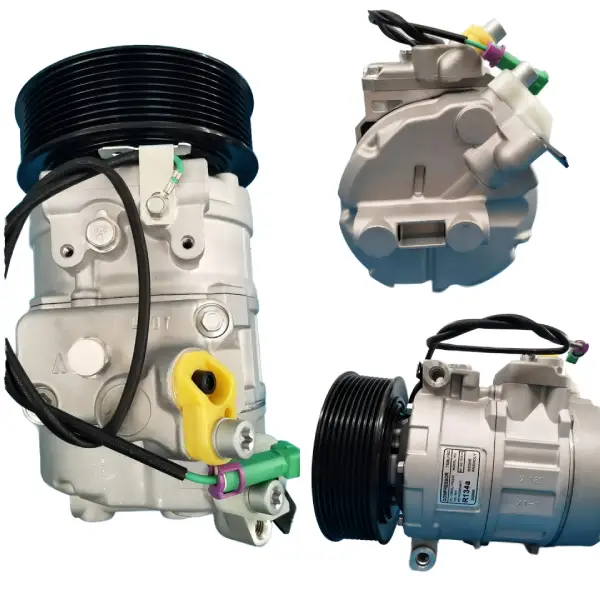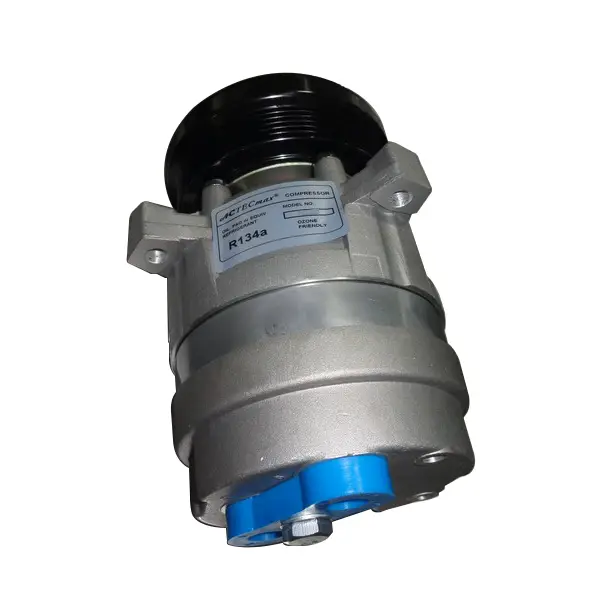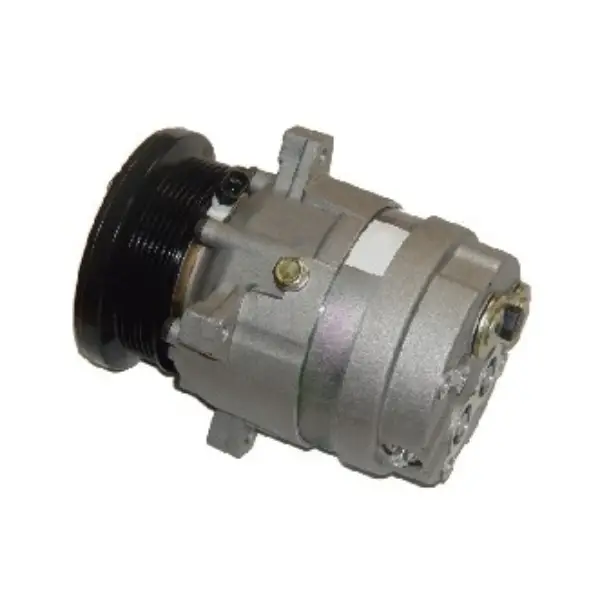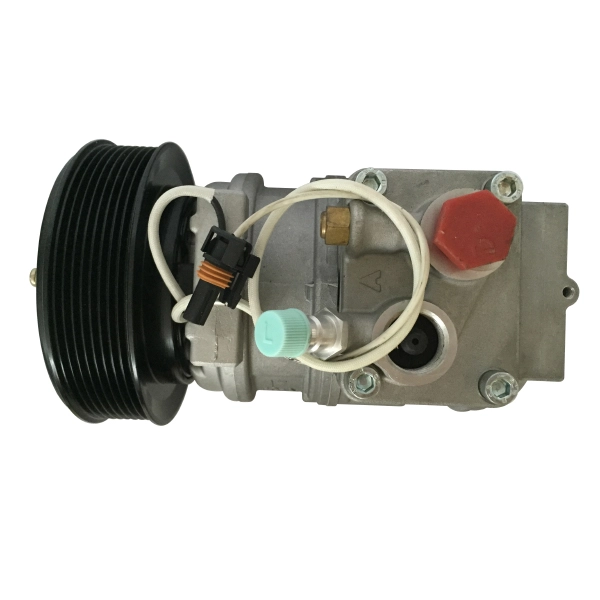

Wobble plate compressors are piston-type and reciprocating compressors, which work similarly to swash plate compressors and sometimes are mistaken as them. However, there are significant distinctions between the two. The post explains the working principle, features and advantages of wobble plate compressors, along with comparison between wobble and swash plate compressors and advice for bulk orders, hoping to help distributors, importers and repair centers to make wise wholesale decisions.
Structure and Working Principle of a Wobble Plate Compressor
A wobble plate compressor mainly consists of a drive shaft, wobble plate, connecting rods, pistons, cylinders, and other components.
When the drive shaft is rotated by the belt pulley, it drives the wedge-shaped drive plate mounted on the shaft to rotate simultaneously. The inclined surface of the drive plate pushes the wobble plate, causing it to oscillate around the central support ball, which acts as a pivot.
Friction between the wobble plate and the drive plate tends to make the wobble plate rotate along with the shaft. However, this rotational tendency is restricted by a pair of anti-rotation bevel gears. As a result, the wobble plate can only oscillate without rotating around its own axis.
The wobble plate then drives the pistons through connecting rods with ball joints at both ends, causing the pistons to reciprocate inside the cylinders. This process is similar to the operation of a syringe, allowing the compressor to complete the suction, compression, and discharge stages.
Features and Advantages
Key Structural Components
- Wedge-Shaped Drive Plate: Fixed to the drive shaft with an inclined end surface. As the shaft rotates, the inclined surface pushes the wobble plate, causing it to oscillate.
- Central Support Ball: Located at the center of the wobble plate, it serves as the pivot for the oscillating motion while also bearing the axial force transmitted by the pistons.
- Anti-Rotation Bevel Gears: A pair of bevel gears is installed on the wobble plate and the compressor housing, respectively. They prevent the wobble plate from rotating with the shaft while allowing it to oscillate.
- Ball-Jointed Connecting Rods: Both ends of each connecting rod feature ball-and-socket joints, transmitting the wobble plate’s oscillating motion into the pistons’ reciprocating motion.
Advantages
- Direct Piston Drive Mechanism: The wobble plate transfers its oscillating motion directly to the pistons through ball-jointed connecting rods, enabling reciprocating piston movement. The power transmission path is straightforward, and the mechanical design is well established.
- Flexible Cylinder Configurations: Different numbers of cylinders, piston dimensions, and stroke lengths can be adopted according to product design requirements to meet different displacement and cooling capacity needs.
- Mature Manufacturing Technology: As an established reciprocating compressor design, the wobble plate compressor benefits from well-developed mechanical design and manufacturing experience, making it suitable for mass production and product series development.
- Flexible Applications: Depending on the specific model and installation requirements, wobble plate compressors can be used in air conditioning systems for passenger cars, commercial vehicles, and certain agricultural and construction machinery.
What Problems Does the Wobble Plate Compressor Mainly Solve?
Single-Head Pistons and Single-Sided Cylinders: Each piston has only one compression head and operates in a cylinder on one side. This requires only one cylinder head and one set of valve assemblies, reducing the number of components, allowing more flexible packaging, and facilitating mass production.
Relatively Easy Implementation of Variable Displacement: Variable displacement can also be achieved by adjusting the wobble plate angle according to crankcase pressure. This allows the compressor to automatically adjust its displacement according to cooling demand without requiring external electronic control.
This helps address a common limitation of fixed-displacement compressors: frequent electromagnetic clutch engagement and disengagement for temperature control, which can cause noticeable changes in cabin cooling, increased fuel consumption, unstable evaporator temperatures, and even evaporator icing.
Differences Between Swash Plate and Wobble Plate Compressors
| Comparison Item | Swash Plate Compressor (Double-Head Piston) | Wobble Plate Compressor (Single-Head Piston) |
| Rotation of the swash plate or wobble plate | The swash plate rotates with the drive shaft. | The wobble plate does not rotate around its own axis; it only oscillates back and forth. |
| Mechanism preventing plate rotation | No anti-rotation mechanism is required. | A central support ball maintains the pivot position, while a pair of anti-rotation bevel gears prevents the wobble plate from rotating. |
| Piston drive mechanism | The pistons are driven directly by sliding shoes. | The pistons are driven by connecting rods with ball joints at both ends. |
| Structure and cost | Fewer components and a compact design, suitable for high-speed operation; however, sliding shoes require high machining precision. | Ball-jointed connecting rods are used with single-head pistons, offering relatively straightforward machining and lower individual component costs. |
| Variable displacement | The mainstream method uses a control valve to regulate pressure and adjust the swash plate angle. | Variable displacement is also possible through a guide pin and curved slot mechanism that adjusts the wobble plate angle. |
| Main wear points | Contact surfaces between the sliding shoes and swash plate. | Ball joints and anti-rotation bevel gears. |
Also Read:What Is a Swash Plate Compressor? A Buying Guide for Automotive A/C Compressors
What Should Buyers Consider When Purchasing Wobble Plate Compressors?
For automotive A/C parts importers, distributors, and wholesale buyers, selecting a suitable wobble plate compressor involves more than identifying its mechanical design.
The following factors should be considered before placing a bulk order:
- Vehicle Compatibility: Verify the applicable vehicle makes, models, engine types, and compressor mounting configurations.
- Technical Specifications: Check displacement, cylinder configuration, operating speed, cooling capacity, and refrigerant compatibility.
- Product Quality: Evaluate manufacturing consistency, component quality, and performance reliability.
- Supply Capability: Consider the supplier’s production capacity, product range, and ability to support repeat orders.
- OEM & ODM Services: For distributors and brand owners, private labeling, customized packaging, and product documentation can also be important considerations.
Working with an experienced automotive A/C compressor manufacturer and supplier can help buyers streamline product sourcing and establish a more reliable supply chain.