
To recharge car AC, start with a simple principle: check for leaks first, vacuum the system second, and charge last. Any refrigerant leak must be repaired before charging, the AC will lose cooling efficiency quickly. Once the system is sealed, vacuuming removes air and moisture, which ensures proper refrigerant circulation.
Vacuuming Before Charging
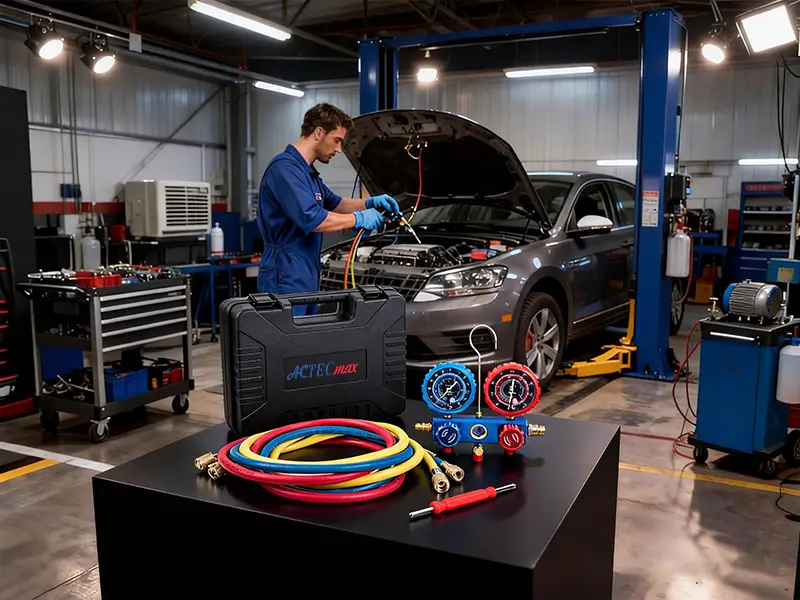
First, connect the manifold gauge to your car AC system. Attach the high-pressure hose (usually red) to the high-pressure port and the low-pressure hose (usually blue) to the low-pressure port. Make sure the connections are secure and there are no leaks at the fittings.

Next, attach the center charging hose of the manifold gauge to the vacuum pump inlet. Open both the high- and low-pressure valves on the gauge, then start the vacuum pump. Let the system run for 15 to 30 minutes, allowing all air and moisture to be removed. You should watch the gauge carefully and ensure it reaches a deep vacuum, typically below -0.1 MPa, which indicates the system is properly evacuated.

After vacuuming, perform a pressure-holding test to check for leaks. Close the manifold valves and the charging port, then wait about 10 minutes. If the gauge pressure stays stable, the system is sealed and ready for refrigerant charging. If the pressure rises, there is a leak that must be fixed before proceeding.
How to Recharge Car AC
There are two main ways to recharge car AC: high-pressure side and low-pressure side. High-pressure charging is faster but riskier, suitable for professionals who handle liquid refrigerants and need quick results. Low-pressure charging is safer and more precise, making it ideal for routine maintenance or for beginners. Regardless of the method, always wear protective gloves and eyewear.
High-pressure Recharging
For high-pressure side charging, the cylinder should be placed upside down and connected to the high-pressure hose. Open the valves slowly, keeping the engine off, then circulate the refrigerant with the engine running for a few minutes before continuing to charge according to the gauge or manufacturer specifications.
Low-pressure Recharging
Low-pressure side charging is simpler: keep the cylinder upright, open the low-pressure valves gradually, and circulate the refrigerant with the AC running to ensure it reaches the correct pressure or weight.
Safety is key. Low-pressure side charging is recommended for most users, while high-pressure side charging should only be performed by trained professionals. Following these steps carefully can save money on mechanic fees and keep your car AC running efficiently.
Recharging your car AC properly ensures a cool and comfortable ride all summer. If the system loses refrigerant frequently, professional inspection may be necessary. For reliable AC recharge kits and automotive AC components, Anchor Group offers high-quality solutions trusted worldwide.