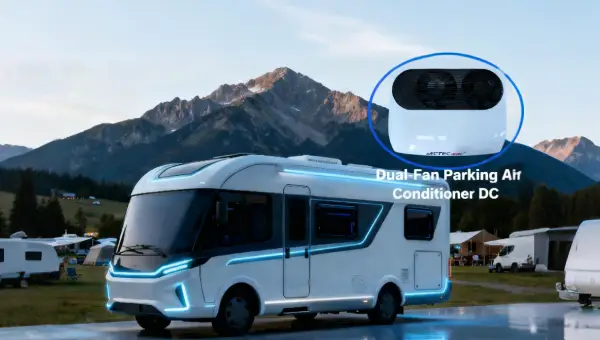

This guide highlights five critical considerations for manufacturers, retrofitters, and distributors when specifying the RV parking air conditioner DC, supported by industry survey data to inform procurement, production planning, and end-user satisfaction strategies.
Match Cooling Capacity With RV Size
Selecting the correct cooling capacity is key when purchasing a parking air conditioner DC for RVs. Matching the unit’s rated capacity to the RV’s interior floor area ensures optimal system efficiency and reliability. Undersized units may run continuously at maximum load, increasing energy consumption and accelerating wear, while oversized units can cause frequent on/off cycling, higher operational costs, and reduced compressor lifespan.
Properly matched cooling capacity supports stable performance, energy efficiency, and long-term system durability, making it a critical factor in design, procurement, and production decisions. The table below provides typical cooling capacity ranges by RV type and floor area based on our survey, offering a practical reference for component specification and sourcing.
| RECOMMENDED BTU BY RV TYPE (COOLING CAPACITY GUIDE) | ||
| RV Type | Floor Area (sq ft) | Recommended Cooling(BTU) |
| Teardrop Camper | 40–60 | 3,000–5,000 |
| Pop-Up Camper | 100–250 | 10,000–12,000 |
| Class B Motorhome | 200–300 | 12,000–15,000 |
| Class C Motorhome | 300–450 | 15,000–18,000 |
| Class A Motorhome | 400–600 | 20,000–25,000 |
| Fifth-Wheel Trailer | 500–1,200 | 25,000–35,000+ |
Adjust BTU for Climate Zone
While cooling capacity is the primary consideration, climate conditions significantly affect the required cooling load. The same RV model may need different AC capacities depending on regional temperatures and heat load. Ignoring climate factors can lead to underperformance or excessive energy consumption.
In T3 (hot) climate zones, larger RVs may require dual-unit configurations or higher total BTU to achieve reliable interior temperature control. Considering climate-adjusted specifications helps ensure consistent system performance, energy efficiency, and long-term reliability across all target markets.
The table below summarizes climate types, typical temperatures, and recommended BTU adjustments, providing manufacturers and retrofitters with a reference for design, sourcing, and production planning.
| CLIMATE TYPE | TEMPERATURE RANGE | TYPICAL REGIONS | HEAT LOAD IMPACT | RECOMMENDED ADJUSTMENT |
| T1 (Mild) | ≤ 85°F | Canada, Northern US, Europe | Low heat load; daytime cooling sufficient, nights cool naturally | Use base BTU (as per RV size guide) |
| T2 (Moderate) | 85–95°F | US Midwest, Eastern Australia | Medium heat load; AC may need to run most of the day | Base BTU × 1.15 |
| T3 (Hot) | ≥ 95°F , hot nights | Phoenix, Nevada, Florida, Middle East, Southeast Asia | Extremely high heat load; AC may need 24-hour operation | Base BTU × 1.3–1.5; consider dual units for large RVs |
Choose an Inverter & Dual-Fan Technology
Of course, new technology should also be considered, as modern advancements like inverters and dual-fan systems can significantly enhance both energy efficiency and cooling performance. These are precisely the factors that your customers care about—lower energy costs, reliable operation, and consistent comfort—so incorporating such technologies into your RV designs or retrofit solutions helps you meet end-user expectations while reducing maintenance and operational challenges.
1. Inverter Compressor (Strongly Recommended)
Inverter compressors dynamically adjust the compressor speed according to the cooling demand, unlike traditional units that operate fully on or off. This technology can improve energy efficiency by 30%, reducing daily power consumption from around 7 kWh to just 3.5 kWh for a 15,000 BTU unit. Because it avoids frequent on/off cycling, the system runs quieter than conventional compressors—making it ideal for restful sleep.
In addition, inverter compressors maintain precise temperature control within ±1°F, ensuring consistent comfort throughout the RV. The lower startup current, only 2–3 times the running current compared to 5–7 times in traditional systems, prevents voltage drops and protects your RV’s electrical system, making it safer for off-grid use.
2. Dual-Fan Design
Modern RV DC air conditioners often use dual condenser fans to enhance heat dissipation. Under light cooling demand, only one fan operates to save energy. During heavy loads, both fans work together to improve cooling efficiency and prevent the compressor from overheating, ensuring stable performance even in hot conditions.
This dual-fan design not only helps maintain consistent interior temperatures but also reduces stress on the compressor, contributing to a longer system lifespan and more reliable operation over the years.
Select an Easy-to-Install & Maintain Design
Moreover, selecting an air conditioner DC design that simplifies installation and maintenance not only reduces labor costs and minimizes downtime for your operations, but also ensures that the end users of your RVs experience reliable, hassle-free performance—helping you meet customer expectations while improving production and retrofit efficiency.
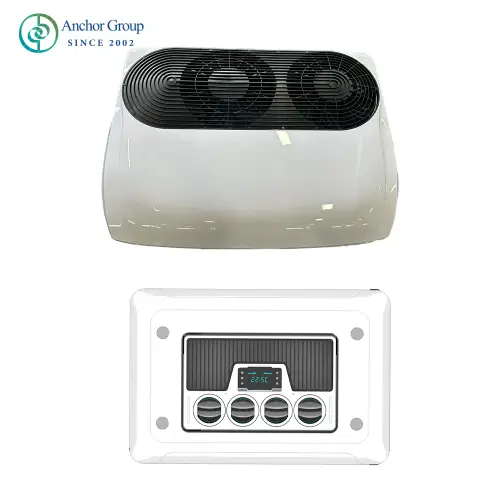
1. One-Piece Rooftop Units (Most Popular)
The one-piece rooftop air conditioner DC integrates all components—compressor, condenser, evaporator, and fan—into a single roof-mounted unit. This compact design makes installation straightforward, usually completed in just a few hours by a professional.
With no separate indoor unit, these systems save interior space, leaving more room for living and storage. Their simplicity, efficiency, and compactness make them the preferred choice for around 90% of RVs, including Class B and C motorhomes and most trailers.
2. Split-System Units (Premium RVs)
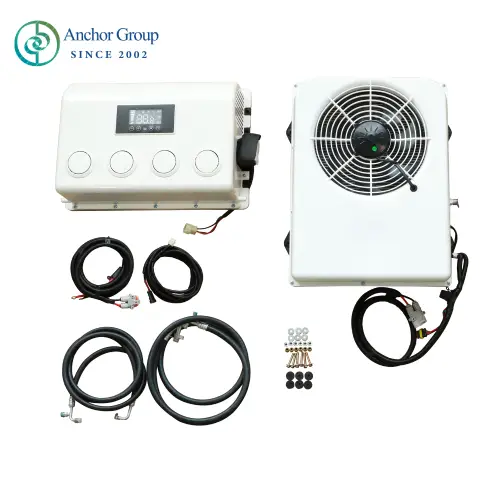
Split-system air conditioner DC, often found in luxury Class A motorhomes and large fifth-wheel trailers, separates the indoor and rooftop units, connecting them with refrigerant lines. This allows for better airflow distribution and more consistent cooling across multiple zones inside the RV.
However, installation is more complex, often requiring wall modifications, piping, and professional vacuuming of the refrigerant lines. While ideal for large or luxury RVs where zoned comfort is a priority, these systems demand higher installation costs and more maintenance effort.
Consider Modern Features of Air Conditioner DC
In addition to cooling performance, modern DC air conditioners offer advanced features that provide operational efficiency, energy management, and added value for manufacturers and operators:
1. Remote & App Control: Enables remote system management, supports multi-zone operation, and facilitates efficient energy use—helping retrofitters offer value-added solutions.
2. Smart Temperature Sensors: Maintain consistent interior temperatures and optimize cooling schedules, improving system efficiency and end-user satisfaction.
3. Battery & Power Monitoring: Provides real-time power usage data, low-voltage protection, and battery runtime estimates—critical for off-grid operations and ensuring reliable system performance.
Conclusion
By carefully considering RV size, climate, inverter and dual-fan technology, installation design, and modern features, manufacturers and retrofitters can select parking air conditioner DC that deliver reliable cooling performance, energy efficiency, and low maintenance, meeting both operational and end-user expectations.
Contact us and explore our latest parking air conditioner DC models to identify the ideal configuration for your RV designs and target climate zones.
Contact Information
🌐 Website: www.onestopacparts.com
📞 Phone: +86 157 2824 1319 / +86 155 5827 6587
✉️ Email: info@acparts.cn
💬 WhatsApp: +86 157 2824 1319 / +86 155 5827 6587