
When the mercury rises and the sun blazes down, maintaining a comfortable cabin environment becomes crucial for any driver. That’s where your car’s air conditioning system steps in, working tirelessly to deliver refreshing cool air. But what exactly should you expect from your Car AC Vent Temperature in such hot conditions? Understanding the normal range and the factors that influence it can not only enhance your comfort but also help you identify potential issues before they become major headaches. Let’s dive into the details of what constitutes a healthy ac air vent temperature and how you can ensure your system is performing at its best, even when the heat is on.
AC Vent Temperature
The temperature of the air exiting the AC vents depends on the ambient (outside) temperature, humidity, and the system’s efficiency. Based on industry standards and empirical data, the following ranges are typically expected for a well-functioning car AC system:
Car Ac Vent Temperature Chart
| Ambient Temperature | Typical AC Performance | Why Vent Temperature May Increase |
|---|---|---|
| ~70°F (21°C) | Around 40–47°F (4–8°C) may be achievable | Relatively low cooling load |
| 80–90°F (27–32°C) | Around 40–50°F (4–10°C) may be achievable | Higher cabin and cooling load |
| 95–100°F (35–38°C) | Vent temperature may rise above 50°F (10°C) | Greater heat load and condenser stress |
| ~110°F (43°C) | Vent temperature may be noticeably higher, especially at idle | Extreme heat load and reduced heat-rejection efficiency |
Note: Under suitable test conditions, a properly functioning car AC system may produce vent temperatures of around 40–44°F (4.4–6.7°C). At an ambient temperature of around 90°F (32°C), temperatures within this range may be achievable, although actual results vary depending on the vehicle and operating conditions.
Also Learn Common Misconceptions of Car Air Conditioner Temperature
These values are general reference ranges, not fixed specifications. Actual car AC vent temperature varies with vehicle design, humidity, solar load, engine speed, compressor capacity, refrigerant charge, condenser airflow, blower speed, and other operating conditions.
A vent temperature that is consistently much higher than expected under comparable test conditions may indicate a problem with refrigerant charge, compressor performance, condenser airflow, the expansion device, evaporator airflow, or HVAC air-mixing controls.
How Car Air Conditioning Works
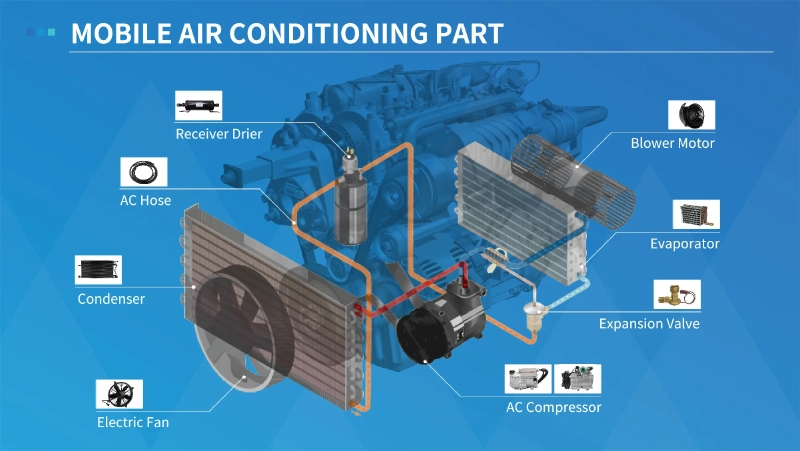
Automotive air conditioning systems transfer heat through the circulation of refrigerant (such as R134a or R1234yf) in a closed loop. The process involves four main stages:
Compression: The AC compressor, driven by the engine belt, compresses the low-temperature, low-pressure gaseous refrigerant into a high-temperature, high-pressure gas. This process consumes about 5-10 horsepower from the engine.
Condensation: The high-pressure, high-temperature gaseous refrigerant then enters the condenser, located in front of the vehicle’s radiator. Here, it is cooled by airflow (assisted by the cooling fan), releases heat to the outside air, condenses (liquefies), and becomes a high-pressure, medium-temperature liquid.
Expansion: The high-pressure liquid refrigerant flows through an expansion valve or orifice tube. As it passes through a narrow restriction, its pressure drops dramatically, causing it to atomize (turn into a fine mist) and partially vaporize, resulting in a low-temperature, low-pressure wet vapor. This is similar to the cooling effect when a spray can is used.
Evaporation: This low-pressure, cold wet vapor enters the evaporator, housed inside the dashboard. It absorbs heat from the cabin air blown across the evaporator’s fins by the blower fan. This cools and dehumidifies the air (removing moisture), and the cooled air is then directed into the passenger compartment. Meanwhile, the refrigerant absorbs heat and fully evaporates, returning to a low-temperature, low-pressure gaseous state, thus completing the cycle.
Six Factors Affecting Car AC Vent Temperature
Ambient Temperature
The ambient temperature directly impacts the condenser cooling efficiency, which in turn affects the Car AC Vent Temperature. High temperatures, especially those exceeding 95°F, can prevent effective cooling of the high-pressure gaseous refrigerant. This reduction in cooling efficiency lowers the overall cooling capacity of the system, resulting in higher Car AC Vent Temperature.
Refrigerant Charge Level
The level of refrigerant charge is crucial for maintaining optimal Car AC Vent Temperature. Insufficient refrigerant lowers the system pressure, reducing heat absorption during boiling in the evaporator. This directly decreases the cooling output, leading to a higher Car AC Vent Temperature. Regular checks and proper refrigerant levels are essential to ensure efficient cooling.
Condenser Efficiency
The condenser plays a vital role in cooling the high-temperature gaseous refrigerant to a liquid state. Blocked cooling fins, dust, or debris, as well as fan failures, can reduce heat dissipation. This results in incomplete refrigerant liquefaction, which negatively impacts the Car AC Vent Temperature by reducing the system’s ability to cool effectively.
Cabin Air Filter Condition
The condition of the cabin air filter significantly affects the Car AC vent temperature. Dust accumulation on the filter restricts airflow through the evaporator, reducing the output of cold air and the efficiency of heat exchange. A clean air filter ensures better airflow and helps maintain a lower Car AC Vent Temperature.
Compressor Efficiency
Wear and tear on the compressor can reduce the refrigerant compression ratio and displacement, decreasing the circulation of refrigerant in the evaporator. This decline in compressor efficiency directly affects the Car AC Vent Temperature, making it harder to achieve the desired level of cooling.
Expansion Valve Operation
The expansion valve regulates the flow of refrigerant into the evaporator. Under-opening of the valve causes insufficient refrigerant supply, while over-opening allows liquid refrigerant to return to the compressor, triggering cooling failure. Proper operation of the expansion valve is essential for maintaining an optimal Car AC Vent Temperature.