
Auto AC Repair is one of the highest-value and most seasonally driven segments in the automotive aftermarket. For vehicle owners, a failed air conditioning system can become one of the most uncomfortable and urgent issues during hot summer months. For auto parts distributors, wholesalers, and professional buyers, understanding how and why key AC components fail is essential for optimizing inventory planning, improving turnover rates, and maximizing profit margins.
Based on our industry experience and market insights, this guide provides a comprehensive failure analysis of common automotive AC wear parts and offers practical wholesale procurement recommendations to help businesses identify high-demand components and make smarter purchasing decisions.
System Architecture & Refrigeration Cycle
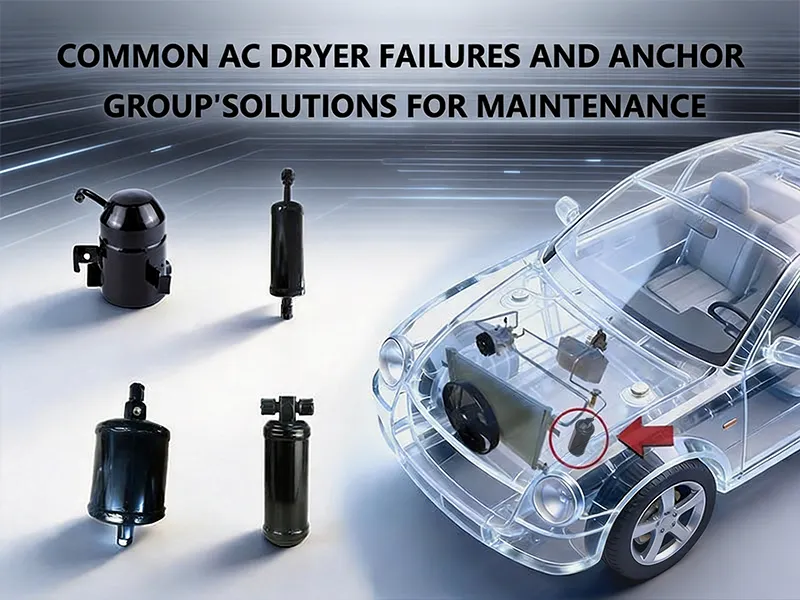
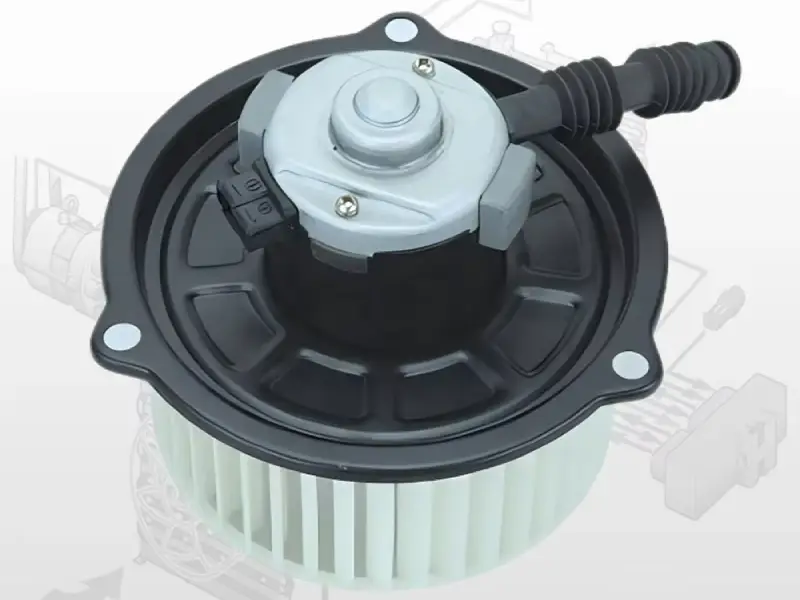
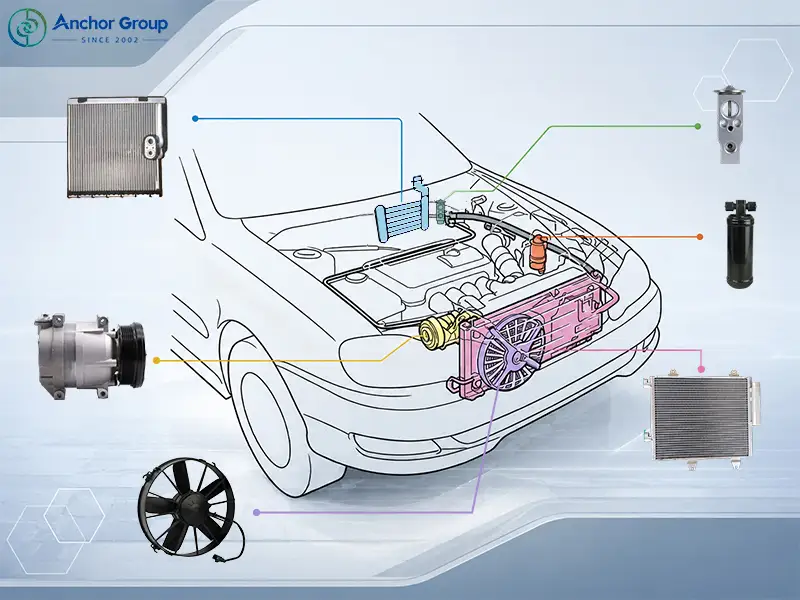
A vehicle AC system is built around four core components — compressor, condenser, expansion device, and evaporator — supported by refrigerant lines, a receiver-drier, a pressure switch, and a blower motor.
It works by continuously circulating refrigerant through these key components. The compressor pressurizes the refrigerant and sends it to the condenser, where heat is released and the refrigerant becomes a liquid. After passing through the receiver drier and expansion device, the refrigerant pressure drops and it enters the evaporator, where it absorbs heat from the cabin air and produces cool air. The refrigerant then returns to the compressor to repeat the cycle.
Most Failure-Prone Components in Auto AC Repair
According to a study, automotive A/C component failures generally follow a Pareto-like distribution, with a small number of key components accounting for a significant proportion of service issues. Among these components, the A/C compressor is considered one of the most critical failure points. Research on compressor failure patterns shows that the compressor pulley, belt, and hub assembly experience the highest failure frequency, contributing nearly 63% of the total compressor-related failure cases. The condenser represents another major failure area, with common problems caused by road-debris punctures, fin blockage from dirt accumulation, and corrosion. Expansion valves may fail due to contamination clogging and thermal sensing bulb malfunctions, while evaporator cores are typically affected by aluminum corrosion leaks, odor-related issues, and condensate drain blockage or icing. Other components, such as pressure switches and receiver-driers, may also contribute to system failures through desiccant deterioration, electrical contact burnout, and moisture contamination.
Root Causes & Faculty Symptoms
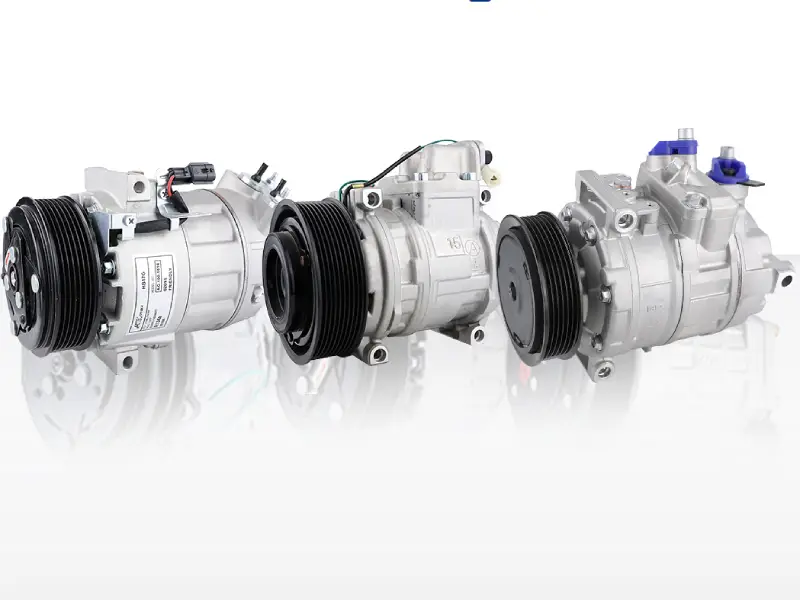
AC Compressor — The System’s Heart
Role: The power source of the entire refrigeration cycle. Highest technical barrier to entry, highest unit price, and highest-value category in the AC parts line.
Failure causes:
- Lubrication starvation : A slow system leak reduces refrigerant charge, and the PAG oil circulating with it is lost along the way. Running the compressor’s pistons or scroll under oil-starved conditions causes rapid internal wear — commonly called “seizure.”
- Clutch burnout: Worn clutch bearings, coil degradation, or voltage instability prevent clean engagement, generating friction heat that burns out the clutch plate.
- Debris ingestion: Metal shavings or fragmented desiccant from elsewhere in the system circulate back into the compressor.
Symptoms:
- Persistent scraping, squealing, or knocking noise from the engine bay when AC is switched on
- No cooling at all, with no clutch engagement visible
- Cabin temperature cycling hot/cold as the compressor short-cycles (repeated engagement/disengagement)
Also Read: How to Quiet a Noisy Car AC Compressor
Condenser — The Front-Line Shield
Role: Mounted at the very front of the vehicle (ahead of the radiator), exposed to the harshest operating environment.
Failure causes:
- Physical damage: Road debris and gravel puncture the thin aluminum tubes at highway speed, causing near-instant total refrigerant loss.
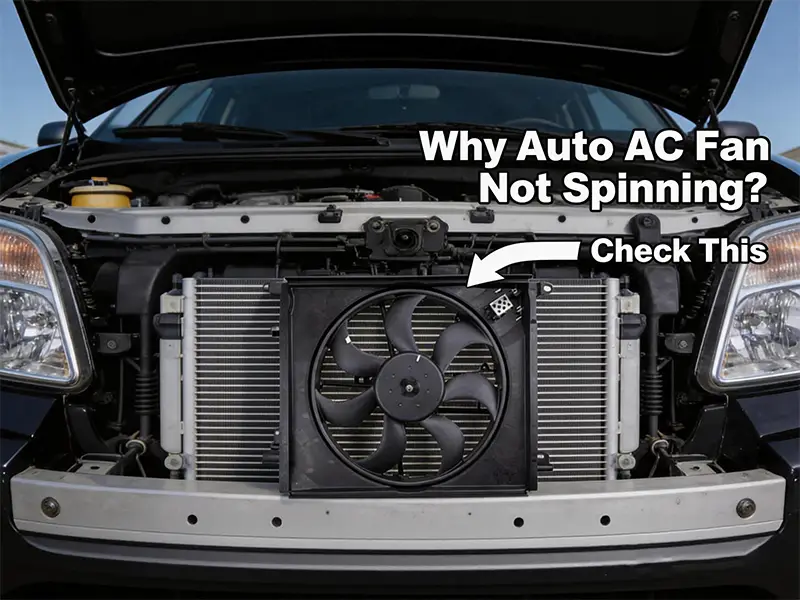
- External blockage: Debris, leaves, and dirt coat the fins, sharply reducing heat-exchange efficiency.
- Chemical corrosion: Road salt and acidic rain accelerate pinhole corrosion in the aluminum.
Symptoms:
- Poor cooling at idle that improves at highway speed (insufficient airflow at idle spikes high-side pressure, triggering a protective cutoff; higher airflow at speed partially restores cooling)
- Visible dark oil residue on the condenser surface (refrigerant oil mixed with dust at the leak point)
- Elevated coolant temperature, as reduced condenser airflow backs up heat toward the radiator
Expansion Valve — The Metering Device
Role: Throttles high-pressure liquid refrigerant down to a low-pressure atomized state.
Failure causes:
- Ice or debris blockage (most common): A failed drier lets moisture into the system, which freezes at the valve’s metering point; or metal particles and carbonized oil sludge from elsewhere clog the fine orifice.
- Spring/sensing bulb failure: A fatigued internal spring or a leaking sensing bulb charge prevents the valve from responding correctly to temperature.
Symptoms:
- Frost or heavy ice buildup on the valve body/inlet line (premature expansion upstream of a restricted valve)
- Intermittent cooling loss: no cooling while ice-blocked, cooling resumes once the ice melts after the vehicle sits, then repeats
- Abnormal pressures: very low (sometimes near-vacuum) low-side pressure paired with elevated high-side pressure
Also Read:Understanding the Function and Symptoms of a Faulty AC Expansion Valve
Evaporator Core — The Hidden Breeding Ground
Role: Buried inside the dash/HVAC housing, responsible for absorbing cabin heat.
Failure causes:
- Acidic corrosion leaks: Constant exposure to a damp, dark environment lets condensate mix with cabin dust, organic matter, and bacteria, forming a mildly acidic film that slowly corrodes the aluminum tubing into pinhole leaks.
Symptoms:
- Noticeable musty/moldy odor the instant the AC is switched on (mold growth on the evaporator surface)
- Slow, chronic refrigerant loss — the system needs a recharge every year, yet no leak is found in the engine bay with a leak detector (the leak is inside the dash-mounted evaporator box)
- Water pooling on the passenger-side floor mat (condensate drain tube blocked, water backing up into the cabin)
Implications for Parts Distributors & Buyers
AC is a highly seasonal category, so inventory strategy and sales approach all hinge on a few industry-specific rules:
Kitting Strategy
A failed compressor typically releases metal debris into the system. That contamination circulates through the lines and will destroy a freshly installed compressor unless the drier and expansion device are replaced and the lines flushed.
Distributors should sell “Compressor Kits” (compressor + receiver-drier + expansion device + seal set) as a bundle. This may raise average order value and can meaningfully reduce repeat compressor returns caused by improper reinstallation, though sellers should treat any specific percentage as an estimate rather than a guaranteed figure.
Timing the Seasonal Stocking Window
AC demand in auto AC repair is sharply concentrated, with peak sell-through in the Northern Hemisphere typically running April through August.
Buyers and large wholesalers should place factory orders and secure ocean freight between the prior October and February, ensuring stock lands in warehouses by late March.
Avoid large speculative reorders after June — demand tails off quickly as summer ends, and late stock risks becoming costly dead inventory.
OEM Cross-Reference & Multi-Platform Fitment
AC components, especially compressors and condensers, are tightly platform-specific across brands, model years, and engine displacements.
Maintain a solid parts cross-reference database (ACES/PIES-style mapping). The same base compressor may fit multiple models (e.g., shared across sibling platforms) but differ in pulley groove count (PV4/PV5/PV6), port orientation, or mounting-ear position — always verify pulley diameter and groove count, mounting position, and inlet/outlet port orientation before sourcing.
Summary
An automotive AC system is a high-pressure, tightly engineered closed loop — and its component failures are rarely isolated. A stone-punctured condenser starves the compressor of oil, causing seizure; a seized compressor sheds debris that clogs the expansion device downstream. For technicians and end buyers, the fix is always system-level replacement and thorough flushing — never a piecemeal repair. For distributors and buyers, the path to sustained margin in this high-value category runs through three disciplines: kitted stocking, and ordering roughly six months ahead of the seasonal peak.