
The reefer truck plays a crucial role in the cold chain transportation industry. When selecting the right reefer truck, multiple factors must be considered, including cargo volume, temperature requirements for transported goods, ambient temperatures, vehicle powertrain, refrigeration unit placement, and the need for backup power. This article provides a detailed analysis of these key factors.
Cargo Volume
The cargo volume of a reefer truck determines the amount of goods it can transport. Common volumes range from a few cubic meters for small vehicles to over 100 cubic meters for large refrigerated semi-trailers. Choosing the right cargo volume requires consideration of cargo size, batch quantity, and delivery routes to ensure efficient loading while maintaining optimal refrigeration performance.
Transported Goods and Their Temperature Requirements
Different types of goods have varying temperature requirements. Some common transported goods and their ideal temperature ranges include:
- Fresh produce (fruits, vegetables): Typically kept between 0°C and 10°C to extend freshness.
- Frozen foods (meat, seafood): Generally require temperatures below -18°C to ensure food safety.
- Pharmaceuticals (vaccines, blood products): Require specific temperature control, typically between -20°C and 8°C, with some biologics needing storage as low as -70°C.
- Dairy products: Usually need to be stored between 0°C and 4°C.
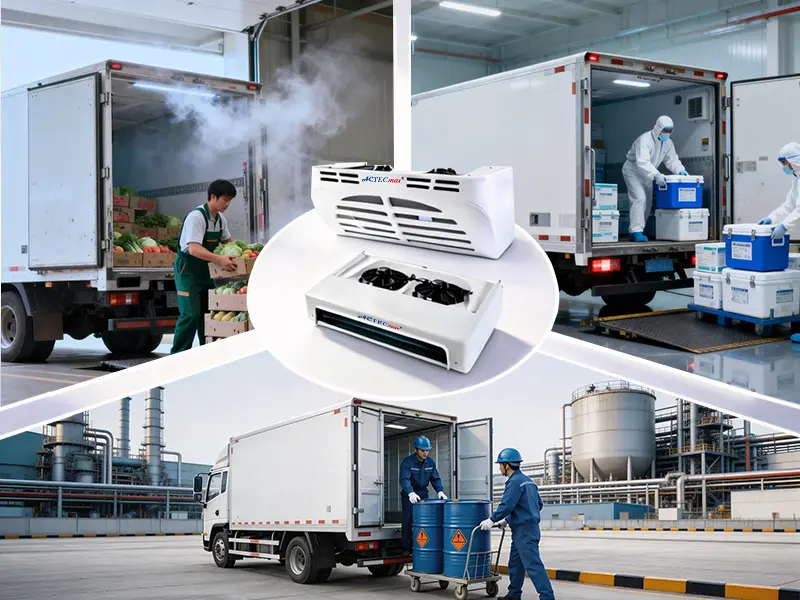
When selecting a reefer truck, it is essential to ensure that its refrigeration system can meet the required minimum temperature and provide precise temperature control.
Ambient Temperature (Average and Maximum Temperatures)
Reefer trucks operate under various environmental conditions, and external temperatures affect refrigeration system performance. For example:
- In hot regions (e.g., the Middle East, parts of Africa), ambient temperatures can exceed 45°C, requiring powerful refrigeration units.
- In cold regions (e.g., Russia, Canada in winter), some goods may require heating systems to prevent freezing.
- In areas with significant temperature fluctuations, the refrigeration system must offer stable temperature control to handle day-night variations.
Vehicle Powertrain: Diesel vs Electric
Reefer trucks primarily come in two powertrain options:
Diesel-powered trucks: Traditional reefer trucks typically use diesel engines to power the refrigeration unit. These are suitable for long-haul transportation, providing strong endurance but consuming more fuel and producing higher emissions.
Electric-powered trucks: With increasing environmental regulations, more reefer trucks are adopting electric power. These vehicles produce zero emissions and lower noise levels, making them ideal for urban deliveries. However, they have limited range and require efficient battery systems.
When choosing a powertrain, factors such as operational costs, environmental regulations, and charging infrastructure availability should be considered.