
What Is an Evaporator Coil in a Parking Air Conditioner?
The evaporator coil of a parking air conditioner is a key heat-exchange component installed on the indoor side of the system. Its main function is to absorb heat from the air inside the vehicle and transfer that heat to the refrigerant. As the low-temperature refrigerant flows through the evaporator coil, it absorbs heat from the cabin air and gradually evaporates. The blower then circulates the cooled air back into the vehicle, helping maintain a comfortable temperature during parking.
Unlike conventional automotive A/C systems, which typically integrate the evaporator inside the HVAC housing behind the dashboard, parking air conditioners often use a more independent indoor-unit configuration. In rooftop parking air conditioners, for example, the evaporator coil is usually integrated into the indoor section of the rooftop unit(which is called Evaporator Assembly), while the condenser is located on the outdoor side. In split-type parking air conditioners, the evaporator is installed inside the indoor unit and connected to the outdoor condenser through refrigerant lines.
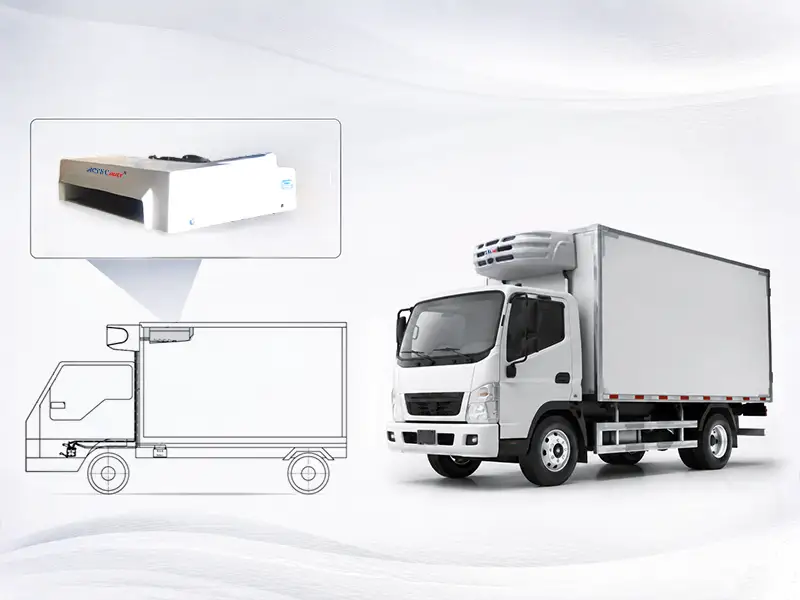
SPLIT PARKING AIR CONDITIONER STRUCTURE
In addition to cooling the cabin, the evaporator also plays a role in dehumidification. When warm and humid air comes into contact with the cold evaporator surface, moisture can condense on the coil and be discharged through the condensate drainage system. Therefore, the design of the evaporator needs to consider not only heat-transfer efficiency but also airflow and condensate drainage.
Also Read:Electric AC for Car: A Complete Parking Air Conditioner Buying Guide for Business
Types of Parking Air Conditioner Evaporator Coils
Guide to Choosing the Right Parking A/C Evaporator Coil
Choosing the right parking air conditioner evaporator coil requires more than simply comparing different materials or structures. The evaporator needs to match the cooling capacity, installation space, refrigerant system, airflow, and overall configuration of the parking air conditioner.
First, consider the application and installation space. Rooftop parking A/C units, split-type systems, truck parking air conditioners, and other vehicle applications may have different space limitations and mounting requirements. The evaporator’s length, width, height, inlet and outlet positions, and mounting points should therefore be confirmed before selecting a product.
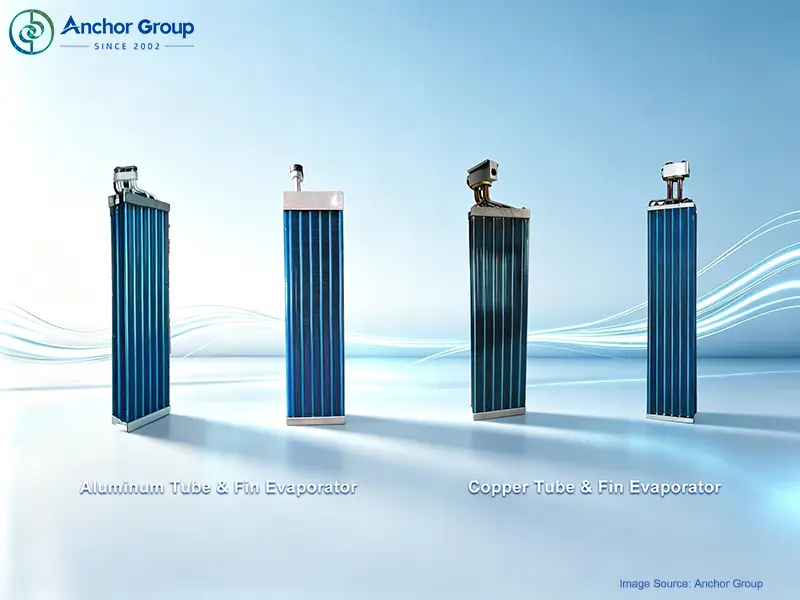
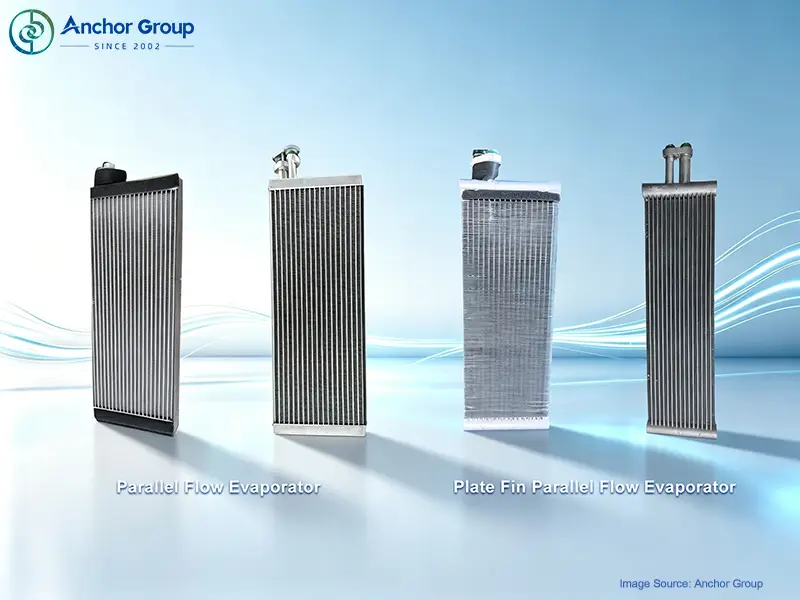
The evaporator structure and material should also match the requirements of the system. Aluminum tube-and-fin evaporators may be suitable when lightweight construction and cost control are priorities, while copper tube-and-fin designs can be considered when ductility, durability, and material reliability are more important. Parallel-flow and plate-fin designs may be preferable when compact construction and efficient heat transfer are required.
Cooling capacity and heat-transfer performance are also important factors. An evaporator with insufficient heat-transfer capacity may not provide the required cooling performance, while an oversized or poorly matched coil may increase system cost and affect overall system efficiency. When evaluating an evaporator, buyers should consider the coil size, fin design, refrigerant flow path, airflow requirements, and the operating conditions of the parking A/C system.
Refrigerant compatibility should be confirmed as well. The evaporator coil must be designed for the refrigerant and operating pressure used by the specific parking air conditioning system. The tube or channel configuration, connection design, and pressure resistance should all be compatible with the intended application.
For B2B buyers, quality consistency and testing are particularly important when selecting evaporator coils for repeated or bulk orders. Key areas include tube expansion quality, tube-to-fin contact, leak testing, dimensional accuracy, corrosion resistance, and overall manufacturing consistency. A product that performs well in a single sample but varies significantly between production batches can create problems for distributors and system manufacturers.
Before placing a larger order, it is advisable to confirm the technical drawing, product specifications, application information, sample performance, and packaging requirements with the supplier. This can help reduce fitment problems and ensure that the evaporator is suitable for the intended parking A/C system.
How to Choose the Right Evaporator Coil Manufacturer and Supplier
Selecting the right parking A/C evaporator coil manufacturer or supplier is just as important as selecting the right evaporator design. For distributors, wholesalers, parking A/C manufacturers, and other B2B buyers, supplier capability directly affects product consistency, delivery reliability, customization, and long-term cooperation.
A reliable manufacturer should have sufficient production capability and quality-control processes for the required evaporator type. Buyers can evaluate whether the supplier has appropriate tube expansion, brazing, fin assembly, leak testing, pressure testing, and dimensional inspection capabilities. These manufacturing processes have a direct impact on evaporator durability and consistency.
Product range and application experience are also worth considering. A supplier with experience in different parking A/C configurations can often provide more suitable solutions for rooftop units, split systems, trucks, vans, and other vehicle applications. A wider product range can also make it easier for distributors and wholesalers to source multiple models from one supplier.
For customized applications, OEM and ODM capabilities can be particularly valuable. Depending on the project, buyers may need customized dimensions, mounting points, tube configurations, fin structures, connection positions, or other specifications. A manufacturer capable of working from technical drawings, samples, or application requirements can provide greater flexibility than a supplier offering only standard products.
For B2B cooperation, the supplier’s production capacity, MOQ, lead time, packaging, technical support, and after-sales service should also be considered. These factors may not directly affect the evaporator’s heat-transfer performance, but they have a significant impact on the efficiency and reliability of long-term business cooperation.
Anchor Group provides parking air conditioner components and evaporator solutions for distributors, wholesalers, and other automotive A/C businesses. With experience in automotive thermal management products, Anchor Group can support different evaporator configurations, including aluminum tube-and-fin, copper tube-and-fin, and parallel-flow evaporator coils, while providing OEM/ODM support, application matching, bulk supply, and customized sourcing according to project requirements.
When choosing a parking A/C evaporator coil supplier, the lowest price should not be the only consideration. A supplier with stable quality, reliable production capability, technical support, and consistent delivery can provide greater value over the course of long-term B2B cooperation.