

With more than 1.4 billion vehicles on the road worldwide and approximately 60 million vehicles requiring automotive A/C service each year, the demand for professional A/C maintenance and repair continues across the automotive aftermarket. As the global vehicle fleet grows, repair shops, dealerships, distributors, importers, and fleet maintenance companies need reliable service tools to diagnose, maintain, and repair automotive A/C systems efficiently. Understanding the different types and applications of HVAC service tools can help B2B buyers build the right product portfolio and make more informed sourcing decisions. In this guide, Anchor Group covers essential and auxiliary A/C service tools, explains their applications, and highlights key factors to consider when selecting and sourcing them for wholesale and bulk purchasing.
Key HVAC Service Tools for Automotive A/C
Automotive A/C servicing requires specialized tools for system diagnosis, evacuation, refrigerant recovery, leak detection, and accurate charging. Among the major A/C service tool categories, manifold gauges, vacuum pumps, recovery machines, leak detectors, and charging scales play important roles in professional A/C service operations.
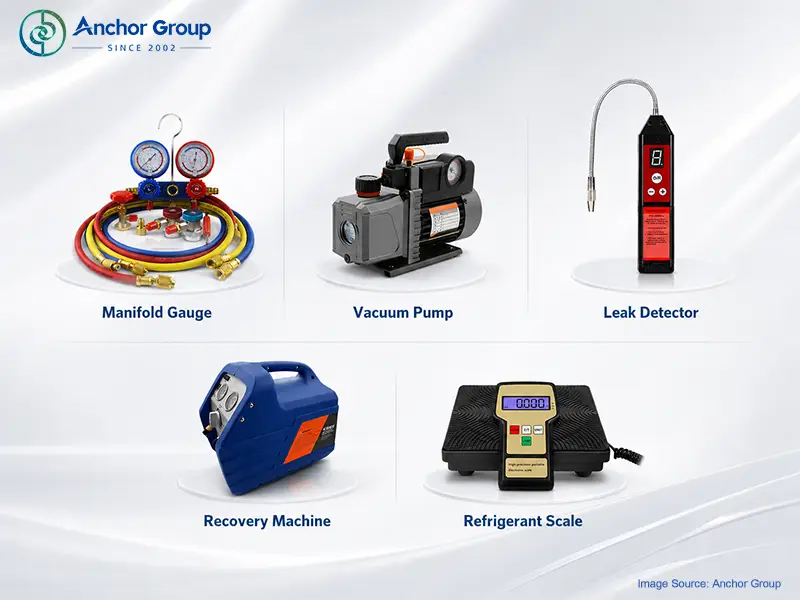
Manifold Gauges
Manifold gauges are fundamental diagnostic tools for automotive A/C systems. They allow technicians to monitor high- and low-side refrigerant pressure, helping identify issues such as insufficient refrigerant, overcharging, or abnormal system operation.
For importers, distributors, and automotive service businesses. important factors include pressure range, gauge accuracy, refrigerant compatibility, hose configuration, fitting standards, and overall durability. Buyers serving different vehicle markets should also consider whether the gauge set supports commonly used refrigerants and service connections.
Vacuum Pumps
An A/C vacuum pump removes air, moisture, and other non-condensable gases from the A/C system before refrigerant charging. Proper evacuation helps prevent moisture-related problems and prepares the system for efficient refrigerant charging.
When sourcing vacuum pumps, buyers should consider pump capacity, ultimate vacuum level, power supply, oil requirements, operating durability, and application compatibility. For repair shops and service networks, reliable performance and ease of maintenance are particularly important.
Refrigerant Recovery Machines
Refrigerant recovery machines are designed to remove and recover refrigerant from automotive A/C systems before maintenance or repair. They help workshops handle refrigerants more efficiently while reducing unnecessary refrigerant release during servicing.
For B2B procurement, buyers should pay attention to refrigerant compatibility, recovery capacity, recovery speed, operating reliability, safety features, and applicable environmental requirements. Compatibility with the refrigerants commonly used in the target market is especially important.
A/C Leak Detectors
A/C leak detectors help technicians identify refrigerant leaks that may not be visible during a conventional inspection. Electronic leak detectors can help locate leaks around components such as hoses, fittings, condensers, evaporators, and compressors.
When selecting leak detection equipment, B2B buyers should consider detection sensitivity, refrigerant compatibility, response time, ease of operation, portability, and durability. The right leak detector can help technicians identify problems more efficiently and reduce unnecessary component replacement.
Refrigerant Charging Scales
Refrigerant charging scales are used to accurately measure the amount of refrigerant added to an automotive A/C system. Accurate charging is important because both undercharging and overcharging can affect cooling performance and system reliability.
For B2B buyers, key considerations include weighing accuracy, maximum capacity, resolution, platform design, portability, display readability, and compatibility with existing service equipment.
Also Read: How to Refill Freon in AC Car: A Step-by-Step Guide to Recharging Your AC System
Auxiliary HVAC Service Tools for Automotive A/C
In addition to core service equipment, technicians also use auxiliary tools to connect service equipment, transfer refrigerant, repair A/C hoses, and assist with leak detection. Although these tools may not perform the primary diagnostic or recovery functions, they are important for completing A/C service work efficiently.
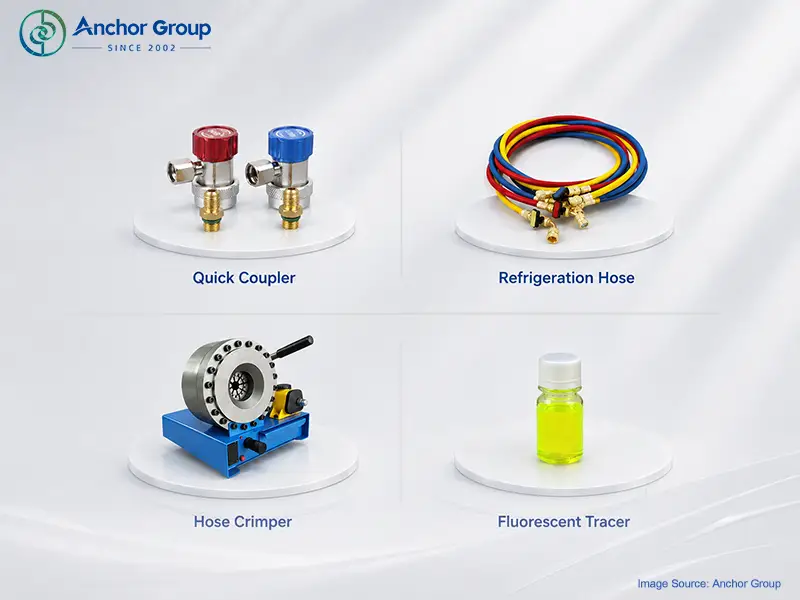
| Tool | Function | Simple Explanation |
| Quick Coupler | Quickly connects and disconnects A/C service equipment from the vehicle’s high- and low-pressure service ports. | For connection |
| Refrigeration Hose | Connects manifold gauges, vacuum pumps, recovery machines, and other service equipment to allow refrigerant flow. | For refrigerant transfer |
| Hose Crimper | Secures fittings to A/C hoses for assembling or repairing automotive A/C hose assemblies. | For hose assembly & repair |
| Fluorescent Tracer | Helps identify refrigerant leaks by making leakage points visible under a suitable UV light. | For leak detection |
For repair shops and distributors, these auxiliary products can also be useful as supporting SKUs alongside core A/C service equipment, allowing buyers to build a more complete automotive A/C service tool portfolio.
How to Choose HVAC Service Tools for Your Business
Choosing the right HVAC service tools depends on the type of business, vehicle applications, refrigerants used, and expected service volume. A repair shop may prioritize durability and ease of operation, while an importer or distributor may focus more on product range, compatibility, pricing, and market demand.
When evaluating automotive A/C service tools, B2B buyers should consider the following factors:
Refrigerant Compatibility
Different vehicles may use different refrigerants, such as R-134a and R-1234yf. Buyers should confirm that the selected equipment is compatible with the refrigerants used in their target market.
Application and Vehicle Coverage
Consider whether the tools are intended for passenger cars, trucks, buses, commercial vehicles, or other vehicle applications. A broader application range can be valuable for workshops and distributors serving different customer groups.
Product Quality and Durability
Service tools are frequently used in professional workshop environments. Buyers should evaluate materials, component quality, accuracy, operating life, and reliability rather than focusing only on the initial purchase price.
Compatibility Between Tools
A complete service setup often involves several tools working together. Buyers should ensure that gauges, hoses, couplers, vacuum pumps, recovery machines, and other equipment use compatible fittings and connections.
Certifications and Compliance
For international B2B sourcing, buyers should check applicable product certifications, safety requirements, and environmental regulations for their target markets.
OEM, ODM, and Packaging Options
For distributors and importers, OEM/private-label packaging, customized specifications, labeling, and product configuration can help differentiate products in local markets.
B2B Sourcing Guide for Automotive A/C Service Tools
For importers, distributors, and automotive service businesses, sourcing HVAC service tools is not simply about finding the lowest unit price. A reliable supplier should be able to provide consistent product quality, stable supply, technical support, and a suitable product range.
Before placing a bulk order, B2B buyers can evaluate suppliers based on:
- Product range and SKU availability
- MOQ and wholesale pricing
- Refrigerant and vehicle compatibility
- Product certifications and compliance
- OEM/ODM capabilities
- Production capacity and lead times
- Quality control
- Packaging and private-label options
- Spare parts and after-sales support
Conclusion
Automotive A/C service requires more than a single piece of equipment. Manifold gauges, vacuum pumps, recovery machines, leak detectors, and charging scales form the core of professional A/C servicing, while quick couplers, refrigeration hoses, hose crimpers, and fluorescent tracers provide essential support during connection, refrigerant handling, hose repair, and leak detection. For B2B buyers, understanding the role of each tool and evaluating factors such as compatibility, quality, durability, certifications, and supplier capabilities can help build a reliable and cost-effective HVAC service tool portfolio.
Anchor Group is an automotive A/C parts and systems supplier with experience in serving international B2B customers. Our product portfolio covers automotive A/C parts & systems, A/C service tools, and other A/C components, allowing customers to source multiple product categories from one supplier.
With OEM/ODM capabilities, quality control, stable production capacity, and technical support, Anchor Group supports importers, distributors, repair businesses, and other automotive aftermarket customers with wholesale and bulk sourcing requirements. Looking for automotive A/C service tools for wholesale or distribution? Contact us for product specifications, pricing, and OEM/ODM solutions.